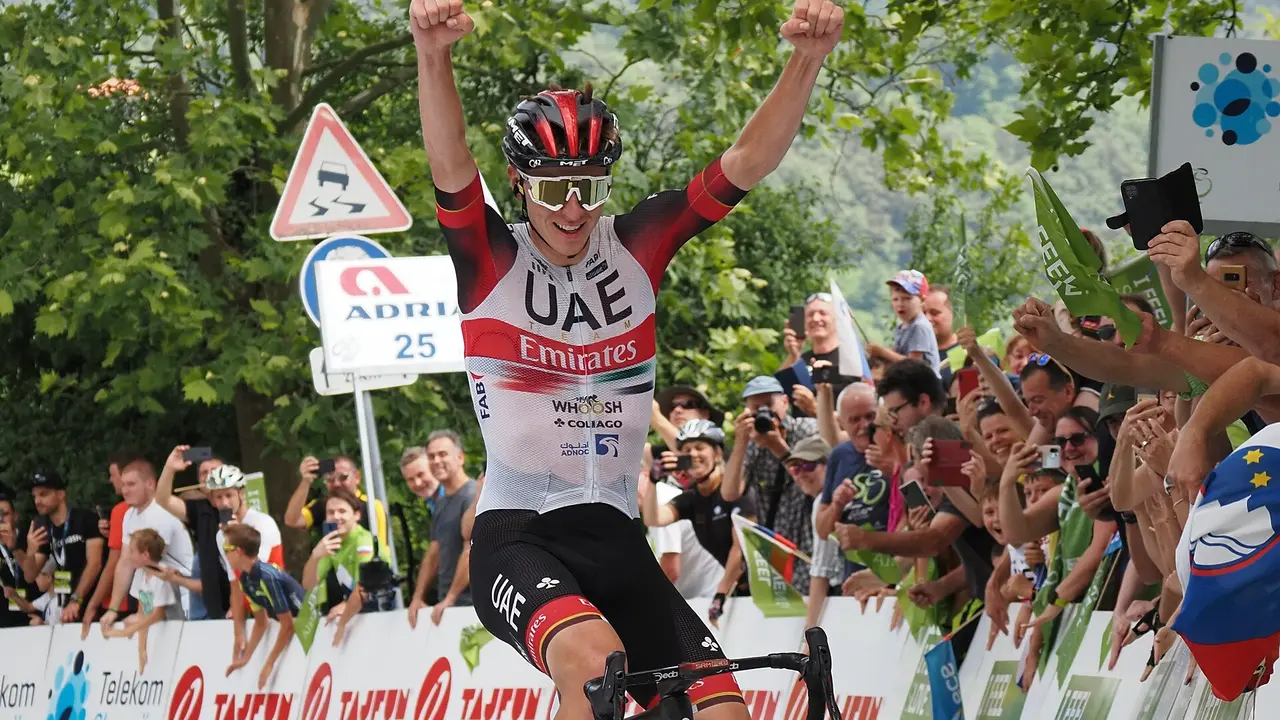
A stone, a few seconds of chaos, and a historic dream shattered. Tadej PogaÄar, the red jersey and the overwhelming favorite of the Vuelta 2026, had to abandon after a spectacularly violent fall during the eighth stage on Saturday, August 29. The five-time Tour de France winner suffers from a concussion, a displaced fracture of the left collarbone, a stable cervical fracture at C7, and multiple abrasions. His condition is stable, and no neurological damage has been detected, but surgery on the collarbone is necessary.
The contrast is brutal. Just moments earlier, the Slovenian was controlling a race that he seemed to have already placed under his authority. He held nearly a four-minute lead in the general classification and had three stage victories in seven days. He aimed for the only Grand Tour of three weeks that was still missing from his palmarès. Now, the cycling world awaits medical news rather than another sporting demonstration.
An Image That Immediately Circulated the Globe
The fall occurred approximately 32 kilometers from the finish in Xeraco, in the province of Valencia. Television footage shows PogaÄar losing control of his bike after a stone appeared on the road. Thrown over the handlebars, he heavily struck the ground with his head and shoulder. Despite his visible injuries, he initially attempted to get back on his bike before realizing he could no longer continue.
The Vuelta confirmed his abandonment. The organization emphasizes that he becomes the first general classification leader forced to leave the race due to a fall since Igor Antón in 2010. This statistical detail highlights the rarity of the scenario: the absolute favorite, clad in red and in full domination, suddenly disappears from the competition due to an unforeseen incident.
The Diagnosis That Calls for Caution
The medical statement from UAE Team Emirates-XRG reassured on one essential point: PogaÄar does not have any other serious injuries or neurological deficits. The fracture of the C7 vertebra is classified as stable. However, the situation remains serious, particularly due to the concussion and the displaced fracture of the left collarbone.
Dr. Adrian Rotunno, the team’s medical director, indicated that the operation on the collarbone would be delayed as a precaution due to the concussion. The rider remains under observation, and the team is expected to communicate further information after the surgery. This timeline serves as a reminder that, in high-level sports, the desire to return quickly cannot take precedence over neurological protocols.
On Sunday, PogaÄar shared a first image of himself from the hospital wearing a neck brace, his face marked, accompanied by the song Stayinâ Alive. The message, both light-hearted and striking, reassured his millions of followers without erasing the gravity of the accident. No return date can reasonably be suggested before the operation and a complete assessment of his recovery.
A Dream of a Triple Crown Stopped in Its Tracks
PogaÄar was returning to the Vuelta seven years after his debut in a Grand Tour. His goal surpassed merely winning an edition: by adding the Tour of Spain to his successes in the Tour de France and the Giro dâItalia, he would have joined the very select circle of riders who have won all three Grand Tours during their careers.
The Slovenian arrived with a stature further bolstered by a fifth Tour de France victory, won in July, his third consecutive. His margin over his rivals at the end of the first week confirmed his status. Three stage wins and nearly four minutes ahead painted an almost unstoppable trajectory. The fall, however, serves as a reminder of the fundamental fragility of cycling: even the most powerful rider in the peloton remains exposed to the terrain, the weather, the road, and the movements of the group.
The Vuelta Changes Face in Seconds
PogaÄar’s withdrawal opens a completely different race. Enric Mas inherits the lead in the general classification, while teams that thought they were defending a place of honor must suddenly consider the final victory. Tactics, temporary alliances, and the management of mountain stages will be redrawn.
For the organization, the loss is also media-related. PogaÄar was the main international draw of this edition. His quest for the last missing Grand Tour attracted an audience far beyond the usual cycling fans. The viewership, global coverage, and commercial narrative of the race relied heavily on this promise. The Vuelta retains its sporting suspense but loses the central story that had propelled it to the forefront.
Road Safety Returns to the Center of the Debate
The team has not assigned any blame, and its sports manager spoke of one of those unfortunate events that are part of cycling. The presence of a stone on an open road later secured for a race can be impossible to prevent entirely. However, the violence of the accident will inevitably reignite discussions about course inspections, road cleaning, and how to instantly signal obstacles.
The debate should not seek a scapegoat without evidence. It must focus on areas for improvement: closer reconnaissance of the peloton’s passage, mobile teams capable of intervening, rapid transmission of alerts from motorcycles, and detection technologies. No system will eliminate all risk, but every major accident forces organizers and governing bodies to examine what could have been avoided.
What This Fall Could Change for the Season
The actual extent of PogaÄar’s absence will depend on the healing of the collarbone, the cervical fracture, and especially the evolution of the concussion. End-of-season appointments take a back seat until doctors establish a timeline. For UAE Team Emirates-XRG, the challenge is now twofold: to protect its leader and to reorganize a Vuelta finale built around him.
For his rivals, the sporting opening is immense but tinged with bitterness. Beating PogaÄar on the road would have given special value to the victory. Taking advantage of his absence is the logic of a race that continues, not the duel the public was expecting. The future winner will have to seize this opportunity while bearing the weight of an edition transformed by an accident.
A Signal That No One Can Ignore
This fall transcends the Vuelta’s standings. It illustrates the thin line between dominance and sudden halt, between constructing a historic achievement and medical urgency. PogaÄar had almost everything under control for a week; a stone was enough to overturn the scenario of the greatest goal still absent from his palmarès.
The global cycling community now holds its breath. The priority is no longer when PogaÄar will win the Vuelta, but how he will recover and under what conditions he can return to competition. The dream of a triple crown will have to wait. After this chilling image, the most important news is simple: the champion is stable, surrounded by his medical team, and out of immediate neurological danger.
Sources
- La Vuelta, official account of the eighth stage and confirmation of the abandonment, August 29, 2026.
- UAE Team Emirates-XRG, medical statement on injuries and planned surgery, August 29, 2026.
- Associated Press via Al Jazeera, circumstances of the fall and sporting implications, August 30, 2026.
- EFE, medical diagnosis and consequences on the general classification, August 29, 2026.