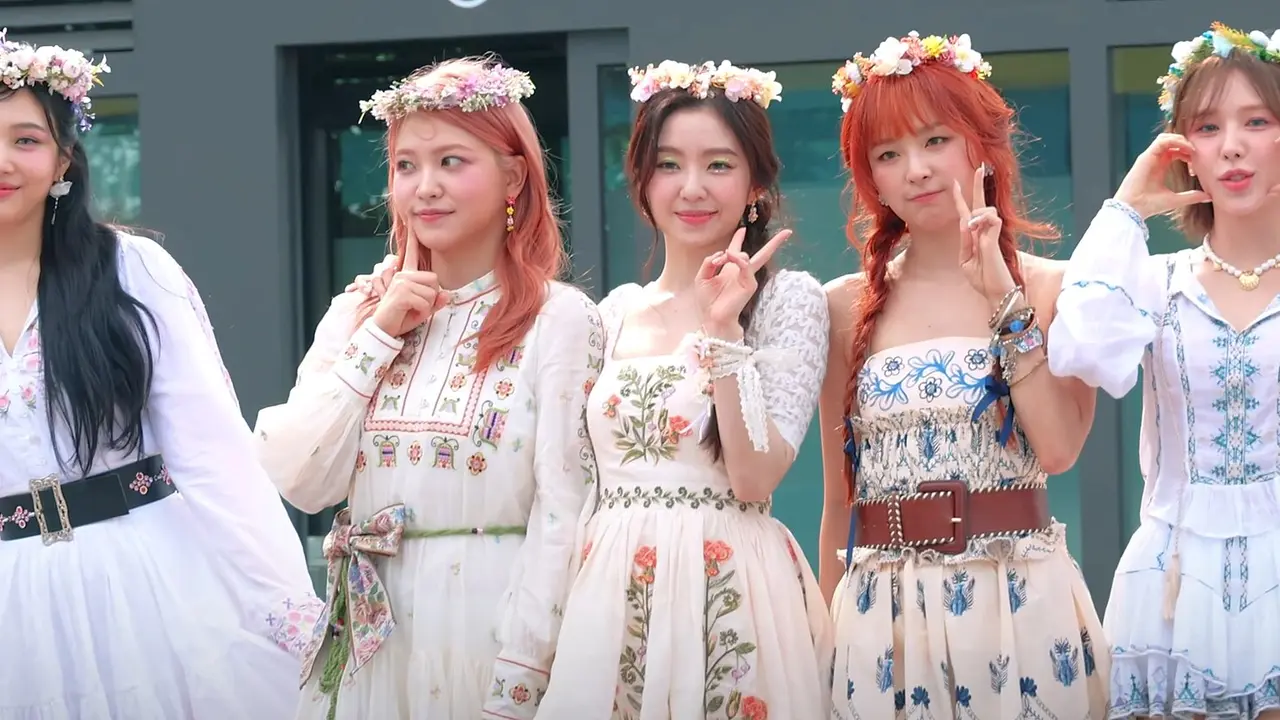
Two years and two months of waiting have come to an end. Red Velvet releases Velvet Summer on August 3, 2026, a mini-album featuring five tracks led by Surfin’ Boy. Irene, Seulgi, Wendy, Joy, and Yeri reunite in an industry where the returns of historic groups have become global events. The promise is clear: to embrace the summer season without imitating the formulas that have already brought them success.
The timing of this comeback adds a special strength to it. The album arrives two days after the group’s twelfth anniversary and the day after the second date of the fan concert A Day in Red & Velvet in Seoul. It follows Cosmic, released in June 2024, and marks the first new collective production since Wendy and Yeri left SM Entertainment for their individual activities while remaining members of Red Velvet.
Why This Return Goes Beyond a Simple Comeback
In K-pop, two years can feel like an eternity. New groups emerge, algorithms redistribute attention, and visual trends change rapidly. Yet, Red Velvet returns with a rare advantage: an immediately recognizable catalog and an identity built around two poles, the bright pop of the “Red” side and the more sophisticated vibes of the “Velvet” side.
Velvet Summer precisely transforms this duality into an argument. Where Red Flavor, Power Up, or Umpah Umpah associated the group with explosive summer energy, the new project claims a calmer, more mature warmth. The members have explained their desire to showcase another color of summer, less saturated, without losing their vocal harmonies or their taste for unexpected arrangements.
The title track, Surfin’ Boy, is presented as a song about the hottest and brightest moments of the season. Its production combines a dance pulse, house elements, a more organic guitar, and a touch of bossa nova. This choice avoids the trap of mere nostalgic homage: Red Velvet recalls its history while seeking a texture suited to 2026.
Five Members, Multiple Agencies: A Signal for the Industry
The real stakes also lie behind the music. Wendy and Yeri ended their individual contracts with SM Entertainment in 2025 and are now working with other structures. Their presence on this project shows that a major group can continue its collective activities despite the dispersion of solo careers. This organization requires more coordination, but it is becoming an increasingly important model for extending the lifespan of K-pop formations.
The complete return thus acts as proof of continuity. Irene, Seulgi, Wendy, Joy, and Yeri do not erase their personal trajectories; they unite them around a strong common brand. For fans, this stability matters as much as sales figures. For labels, it demonstrates that an established catalog can remain active without locking each artist into total exclusivity.
K-Pop No Longer Just Sells Songs
The launch of Velvet Summer illustrates a mechanism that has become central in global entertainment. The physical album exists in several collectible versions, while the platforms stream the tracks simultaneously on an international scale. Concept photos, the music video, social content, and the fan concert form a single narrative designed to transform a musical release into a community event.
The Seoul concert itself was offered via streaming through Weverse and Beyond LIVE, with a replay scheduled for August 5. The announced price for physical tickets was 143,000 won, taxes included. This combination of venue, digital sales, merchandise, and global access demonstrates how K-pop monetizes engagement without relying solely on streaming listens.
The mini-album contains only five tracks, a short format that also responds to current practices. It allows for a strong media focus, multiplies physical versions, and quickly reintroduces the entire group catalog into playlists. The challenge now will be to convert the enthusiasm of the first day into sustainable performances, beyond the coordinated purchases by fandoms.
A Global Summer Battle Already Underway
Red Velvet does not return to an empty space. The August calendar is packed, with other major releases expected and KCON Los Angeles scheduled from August 14 to 16. This density confirms that K-pop now operates as a global industry with a continuous flow, capable of occupying platforms, venues, and online conversations from Seoul to Los Angeles.
The strength of the group lies in its difference. Twelve years after its debut, Red Velvet no longer needs to chase every new trend. Its return can, on the contrary, appeal to multiple generations: long-time fans reunite with the five members, while a younger audience discovers a discography that has become a reference for vocal harmonies and hybrid concepts.
Why France and Europe Should Watch This Comeback
In France, K-pop has evolved from a niche passion to a visible force in charts, social media, and large venues. European communities no longer wait for local broadcasts to participate in a release: they follow teasers in real-time, order albums, translate interviews, and bring songs to life as soon as they are released in Korea.
The case of Red Velvet also interests the European cultural economy. It showcases the value of a coherent artistic universe, maintained over the long term, and the ability of a group to return without renouncing its identity. As French artists also seek to build international communities, this discipline of narrative, image, and timing offers a powerful lesson.
The Verdict Will Begin After the Initial Explosion
Immediate reactions already praise the more laid-back atmosphere of Surfin’ Boy and the return of the vocal layers that distinguish the group. However, real success will be measured over several weeks: Korean charts, international listens, physical sales, the virality of the music video, and the ability of the song to stand out against upcoming August releases.
One thing is certain: Red Velvet has just reminded us why the comebacks of established groups remain so powerful. Velvet Summer is not just a seasonal album. It signals that a formation can survive separate contracts, breaks, and the accelerated renewal of K-pop. Twelve years after its debut, the group does not ask for permission to return: it reclaims its place with a calculated softness that could become the global sound of this late summer.
Sources
- YES24 / Kakao Entertainment, August 3, 2026, release date, five-track format, title track, and context of the return.
- The Korea Times, June 16, 2026, confirmation of the full comeback and return after two years.
- Weverse, official announcement of the fan concert, dates, location, and ticketing.
- Weverse, global streaming of the concert and replay schedule.
- ChosunBiz, July 20, 2026, musical positioning of Surfin’ Boy.