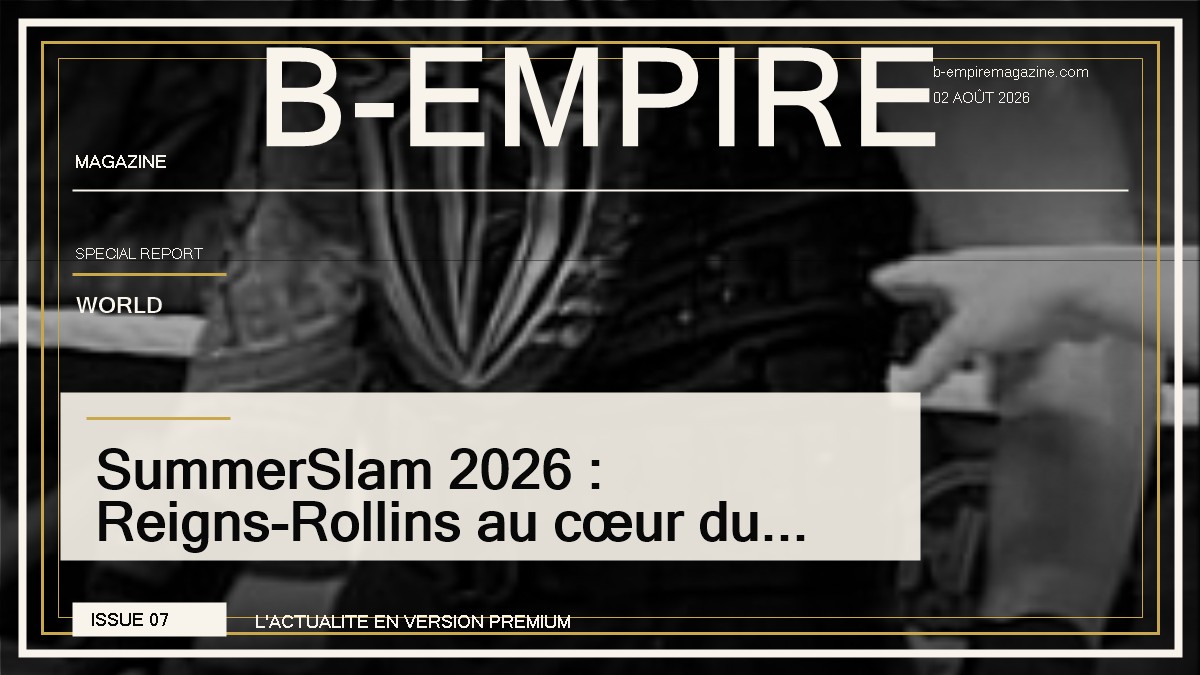
The world of wrestling enters its most electrifying night of the summer. This Sunday, August 2, SummerSlam 2026 is set to close in Minneapolis, marking a weekend built as a true global summit of sports entertainment. At the center of the card, Roman Reigns and Seth Rollins will clash for the heavyweight championship, more than a decade after they built the legend of The Shield together. But behind this spectacular rivalry lies an even greater battle: the transformation of WWE into a global streaming product capable of occupying two nights, a stadium, and multiple media markets simultaneously.
SummerSlam is no longer just the summer gathering for wrestling fans. The 2026 edition serves as a real-world test for the economic model of TKO, WWE’s parent company. In the United States, the event is broadcast on the ESPN app with the ESPN Unlimited offering. In many international territories, Netflix extends the global strategy initiated with Raw and the immense WWE catalog. Two platforms, two distribution logics, and one shared ambition: to transform live events into a global cultural conversation.
A Second Night Where Everything Converges Towards Reigns and Rollins
WWE has placed Roman Reigns against Seth Rollins at the top of the Sunday night card. This choice is not solely based on the power of two names. It relies on a shared history that the audience has known since the days of The Shield, a group that has become one of the most significant constructs in modern wrestling. Since their split, Reigns and Rollins have followed opposite trajectories, crossing paths regularly without ever exhausting their rivalry.
Their duel possesses a rare advantage in todayâs attention economy: it can be understood immediately while rewarding loyal viewers. For newcomers, it is a championship match between two global stars. For long-time fans, every glance and every reference harkens back to over a decade of betrayals, alliances, and transformations. This narrative depth distinguishes WWE from traditional sports and series: its story is written live, in front of an audience that already knows the previous episodes.
Two Nights to Make SummerSlam a Summer WrestleMania
WWE and Minnesota Sports and Events have announced SummerSlam 2026 as a two-night event at U.S. Bank Stadium. The stadium, home to the Minnesota Vikings, has already hosted Super Bowl LII and the Men’s NCAA Final Four. WWE is staging a stadium event here for the first time, with activities for fans and the community before and after the shows.
This transition to two nights changes the dimensions of the event. It offers more space for major rivalries, multiplies potential ticket sales, extends visitor stays, and produces two distinct peaks on social media. It also brings SummerSlam closer to the WrestleMania model, which has become as much an urban festival as a wrestling night. Minneapolis is not just receiving a ring: it is hosting supporters, hotel expenditures, ancillary events, and international exposure.
However, the risk exists. Two nights require two strong cards to maintain attention, especially when the audience already has access to an almost unlimited array of sports and cultural offerings. Expansion is only sustainable if each night feels indispensable. This is precisely why WWE has distributed its most powerful matches, from CM Punk vs. Cody Rhodes to Brock Lesnar vs. Oba Femi, leading up to the Reigns-Rollins clash.
ESPN and Netflix: The Real Battle Also Takes Place Outside the Ring
ESPN has prepared SummerSlam as a week-long programming event, with a dedicated special and three hours of countdown before each of the two nights. This strategy reveals the value that the network places on WWE: not merely as a one-off broadcast, but as a machine for producing stories, debates, and time spent within its digital ecosystem.
Internationally, Netflix has already demonstrated WWE’s ability to create a global weekly appointment. A report published by the platform in January 2026 indicated that Raw had entered the global Top 10 of English-language series for 47 weeks out of 52 since its debut on Netflix. WWE accounts related to this universe had also generated over 4.4 billion impressions on social media in a year. These figures explain why SummerSlam transcends niche status: wrestling provides platforms with live, recurring, highly social content that is difficult to replicate.
However, the broadcasting modalities are not the same in all countries. Netflix Tudum confirms ESPN in the United States and Netflix in a long list of markets, while local catalogs and agreements may vary. In France, fans must therefore check directly the schedule and availability displayed by their service. This fragmentation itself tells the story of the new age of sports rights: a global event may be visible everywhere, but not necessarily through the same path.
Brock Lesnar vs. Oba Femi: The Clash of Generations
The presence of Brock Lesnar against Oba Femi in a Hell in a Cell structure provides another key to understanding this edition. WWE pits an attraction established for over twenty years against an emerging powerhouse it wants to elevate to a new dimension. This is one of the most effective mechanics in wrestling: using the credibility of a legend to measure, and then accelerate, the rise of a new face.
Oba Femi also represents the internationalization of the talent pool. Born in Nigeria, he embodies a generation whose origins, audiences, and trajectories far exceed the American framework. In an industry seeking to gain traction in Africa, Europe, the Middle East, and Asia, building new global stars is not just a creative decision. It is a strategic investment.
Why France Should Watch This Shift
France has long had a community of wrestling fans, nurtured by television, European tours, video games, and social media. However, the streaming model is changing the relationship with the product. Major rivalries now circulate almost simultaneously, clips go viral within minutes, and French commentary interacts directly with that from the United States, the United Kingdom, Mexico, or Nigeria.
This phenomenon also interests the entertainment economy in France. Major events no longer sell just a ticket: they sell a destination, an extended experience, and a digital community. Paris, Lyon, or Marseille already know the strength of weekends built around football, concerts, and conventions. SummerSlam shows just how far this logic can be industrialized when a brand has global characters, continuous storytelling, and powerful broadcasting partners.
The Signal That the Entertainment Industry Cannot Ignore
The outcome of the matches matters to fans, but the economic verdict will be broader. WWE must prove it can expand SummerSlam without diluting its exceptional character. ESPN wants to confirm that wrestling can attract and retain subscribers on its app. Netflix seeks to strengthen its status as a global destination for live events and the content surrounding them.
This convergence explains the particular tension of the night. When Roman Reigns and Seth Rollins enter the stadium, they will carry a personal story and a championship. They will also carry the demonstration of a model where sport, series, concert, and platform merge. SummerSlam 2026 promises not just a winner: it measures wrestling’s ability to become one of the most universal languages of global entertainment.
Sources
- WWE â Official Match Cards for SummerSlam 2026, July 27, 2026.
- ESPN Press Room â SummerSlam Broadcast and Special Programming, July 27, 2026.
- Netflix Tudum â Schedules, Match Cards, and Broadcast Markets, July 15, 2026.
- WWE Corporate â Minneapolis Selection and Two-Night Format, May 23, 2024.
- Netflix â Global Report on One Year of WWE on the Platform, January 6, 2026.