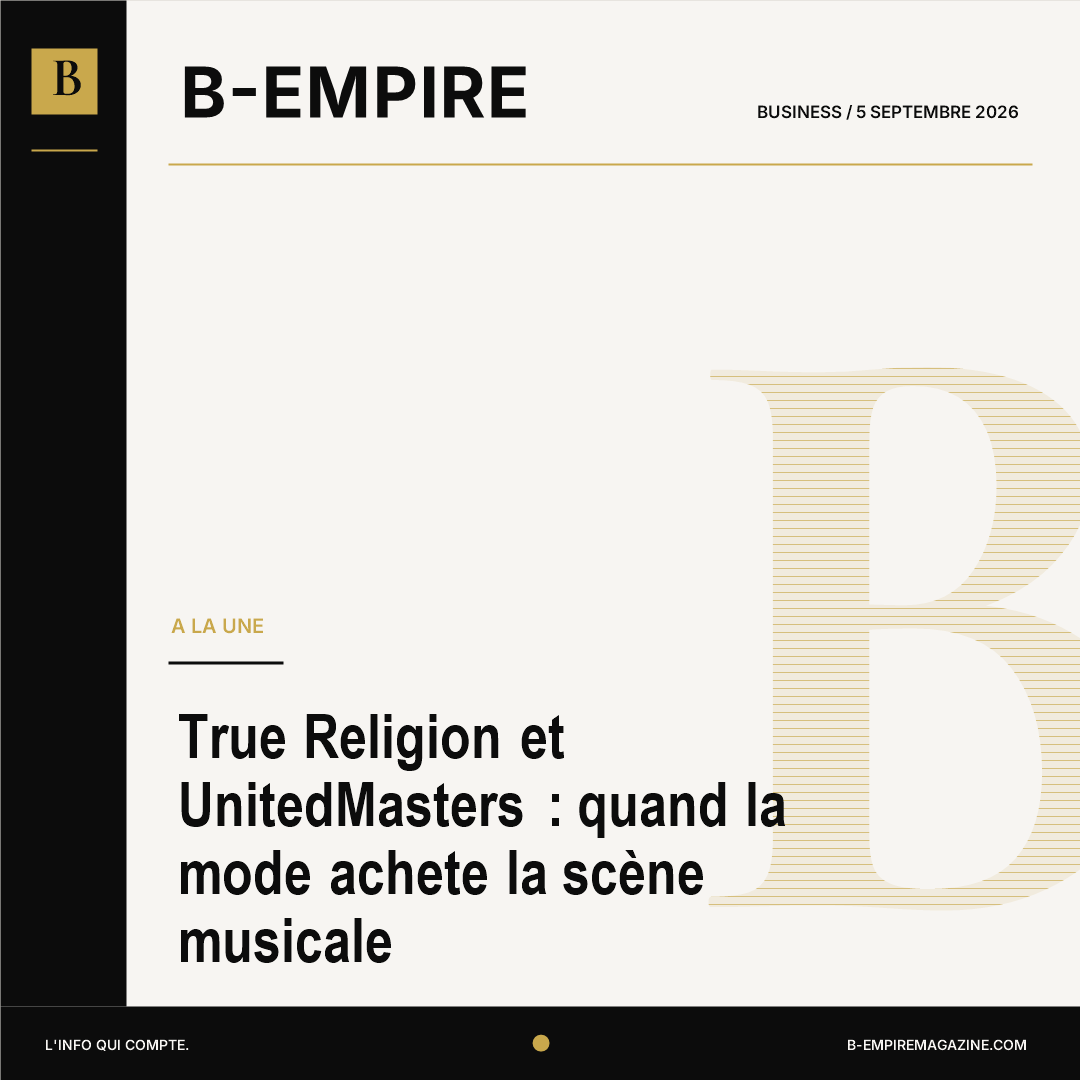
True Religion no longer wants only to sell jeans. The brand wants to buy into a cultural moment. On September 4, 2026, the American label announced with UnitedMasters the launch of True Religion On Tour, a concert series that will begin in New York on September 10, just as Fashion Week puts the city back at the center of the global conversation. The format promises more intimate performances, in-store experiences, curated playlists and direct contact with Gen Z and millennial audiences.
The news may look like a seasonal activation. It says far more about the state of the fashion business. Brands are no longer trying to connect with music merely to decorate a campaign. They want to participate in the infrastructure that links artists, fans, physical spaces and social content. In that equation, UnitedMasters is not simply an event supplier. The platform presents itself as a distribution and partnership tool that allows independent artists to keep ownership of their masters while accessing brand collaborations.
A Tour, Not an Advertisement
The choice of the word tour is central. True Religion could have bought a party, sponsored an after-event or placed its logo inside a venue. Instead, the brand is choosing a structure that unfolds over time: New York in September, Atlanta in October, Houston in November, Los Angeles in December, then a second year announced for February 2027. Fashion is borrowing the language of live music, with dates, cities, local communities and progressive anticipation.
It is a smart way to escape the overly brief campaign cycle. An ad lives for a few days in feeds. A tour can produce images, memories, conversations, looks and micro-stories for months. For a denim brand returning through Y2K nostalgia and streetwear energy, the music stage offers legitimacy that media buying alone cannot manufacture.
The Comeback as Raw Material
True Religion enters this operation with a very specific commercial story. Forbes noted in June that the brand had gone through two bankruptcies before returning to solid growth, with 470 million dollars in sales the previous year and an ambition to reach one billion dollars within five years. That return did not come from restoring nostalgia exactly as it was. It was built through a repositioning toward a younger, more urban, more diverse customer who responds to hip-hop, pop and social media codes.
The collaboration with UnitedMasters therefore extends a transformation already underway. True Religion is no longer speaking only to the old premium-denim customer of the 2000s. It is speaking to consumers who discover the brand through artists, influencers, music videos, platforms and archives recirculated by TikTok. The horseshoe logo becomes less a memory than a sign available to a new generation.
Why UnitedMasters Is the Logical Partner
UnitedMasters occupies a strategic place in this landscape. The platform founded by Steve Stoute promises artists worldwide distribution, access to marketing services, sync opportunities and collaborations with brands. Its pitch rests on a simple idea: the independent artist should not merely publish music, but control the commercial value of their community.
For True Religion, that is exactly the kind of interface a brand needs. Fashion can no longer simply identify a celebrity and buy their image. It has to understand finer networks of influence: emerging artists, local scenes, digital communities, highly engaged fans, short formats, playlists and physical meetings. UnitedMasters brings that grammar. The brand brings product, place and visual memory.
New York Fashion Week as an Accelerator
The timing is not accidental. New York Fashion Week is also changing. Vogue describes a Spring 2027 edition where major returns coexist with debuts, anniversaries, social events, exhibitions and urban movement. The week is no longer just a sequence of shows reserved for the industry. It is becoming a constellation of content, parties, launches and parallel stages.
In that context, True Religion does not need a classic runway to exist. A well-placed concert can be more effective than an expensive show, especially if the brand wants to reach an audience that consumes fashion in fragments: a jean seen on stage, an artist filmed by fans, a shared playlist, a backstage video, a look worn in a specific city. Fashion Week supplies the media noise; music supplies the emotion.
Denim as Cultural Language
The moment is also favorable for denim. GQ notes that fall 2026 is still shaped by wider cuts, 1990s references, vintage jeans, worked materials and the return of a clothing authenticity less obsessed with pure novelty. For True Religion, that trend is a window. Jeans are not only a basic product; they are again a carrier of identity.
Denim’s strength lies in its ability to circulate. It can belong to the street, luxury, the club, the campus, the stage and everyday life. That is exactly what a brand seeking to become cultural again needs. The concert shows the garment in living use, not in an over-controlled image. The audience does not only look at the product. It sees it worn, sweated in, photographed, mixed with music and movement.
Independence as a Commercial Argument
The message of independence is the other key element. UnitedMasters speaks of artists who own their masters, direct relationships with fans and partnerships that move beyond the old model of the dominant label. True Religion borrows that vocabulary to its advantage. In a market saturated with collaborations, independence becomes a brand value: it suggests freedom, creation without permission and proximity to communities.
That promise still has to be read clearly. A sponsored tour remains a marketing tool. The question is not whether the brand is disinterested. It is not. The real question is whether the exchange creates value for artists as well as for the label. If the concerts offer a stage, payment, visibility and a lasting relationship to artists, the model can be more credible than disposable influencer marketing.
What Brands Are Learning From Creators
The operation also shows that fashion brands are learning from digital creators. Creators know how to turn an audience into an appointment, an appointment into content and content into commerce. Brands are now trying to reproduce that loop without seeming artificial. That is why local scenes, selected artists and intimate formats matter. The closer the experience feels, the farther it can travel online.
This logic could become one of the major competitive fields of 2026. Brands able to create real moments will have an advantage over those that only produce images. Audiences know how to recognize empty staging. They reward devices where something actually happens: a concert, a conversation, a queue, an unreleased song, a city responding to a brand.
The Risk of Opportunism
The strategy carries an obvious risk. Music does not always forgive opportunism. If the brand uses artists as scenery, the operation can turn against it. Younger audiences accept commercial partnerships, but they want to feel coherence. True Religion has an advantage here: its return has already been fed by hip-hop culture, streetwear and Y2K memory. The link with music is not invented from scratch.
But coherence will have to be proved in execution. The chosen cities, the artists, access to the events, the quality of the experience and the role given to local communities will make the difference. A cultural tour is not judged only by its press release. It is judged by the lines at the doors, by the videos fans want to post and by the way artists come out of the operation.
A Signal for the Industry
This partnership is a signal for the whole sector. The next battle in fashion will not be fought only on product, price or the advertising algorithm. It will be fought on the ability to build a lasting cultural presence. Brands will have to become editors, programmers, meeting platforms and sometimes producers of stages.
True Religion and UnitedMasters are testing a form that could multiply: a brand with a strong identity, a platform connected to independent artists, a series of cities, a calendar linked to fashion and a promise of proximity. Denim becomes the ticket in. Music becomes the proof of life. And growth, in this new cultural economy, increasingly depends on the ability not only to be worn, but to be lived.
Sources
- PR Newswire, September 4, 2026, announcement of the True Religion and UnitedMasters partnership.
- Forbes, June 22, 2026, analysis of True Religion’s business comeback.
- UnitedMasters, official page on mission, partnerships and master ownership.
- UnitedMasters, artists page, distribution offers and brand opportunities.
- Vogue, preview of New York Fashion Week Spring 2027.
- GQ, September 5, 2026, fall 2026 denim trends.