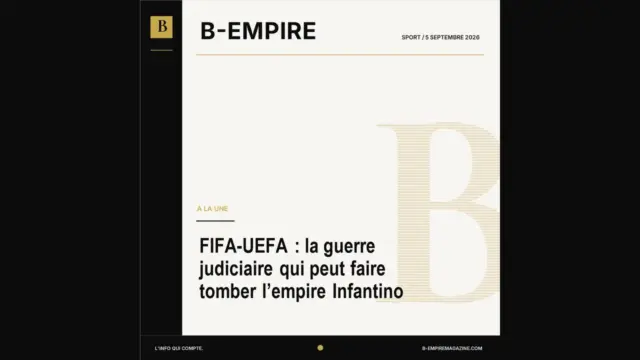
Just eleven days after a World Cup final meant to celebrate the unity of football, a historic rift has opened at the top of global sport. UEFA and its 55 national federations have announced that they will no longer participate in FIFA competitions if Gianni Infantino‘s proposal to open a portion of the largest tournaments to private investors remains on the table. The threat encompasses the World Cups, women’s competitions, youth tournaments, and the Club World Cup. For the French team, as for all major European nations, this is no longer a dispute among leaders: it is an ultimatum that could change the geography of football.
The conflict revolves around a project dubbed FIFA Forward Enterprise, or FFE. According to detailed information from the Associated Press, FIFA aims to consolidate its commercial activities into a subsidiary valued at around $20 billion, of which 20% would be open to private capital. The main anticipated investor would be a New York fund created by Joshua Kushner, brother of Jared Kushner. FIFA would officially retain sporting control, but Europe believes that the entry of external shareholders would create ongoing pressure on revenues, scheduling, and the format of competitions.
An Unprecedented Ultimatum from the 55 European Federations
Meeting urgently on Thursday, July 30, the member associations of UEFA adopted a common position. They unanimously and unequivocally reject the transfer of interests in the World Cup and other FIFA competitions to private investors. Their red line is explicit: no European team will participate in FIFA tournaments as long as the project has not been completely abandoned and binding guarantees have not been provided to prevent future privatization.
The wording is much stronger than an institutional protest. It potentially implicates France, Spain, England, Germany, Italy, Portugal, the Netherlands, and all other European federations. Without these teams, a World Cup would lose a crucial part of its sporting level, audience, sponsors, and television value. The European threat thus directly attacks the economic heart of the project.
Why Gianni Infantino Wants to Open the Door to Private Capital
Gianni Infantino presents the operation as a development accelerator. The proposal addressed to the 211 member federations aims to double their base funding for the next cycle, from $10 million to $20 million. In the long term, FIFA projects up to $86 million to be paid to each association by 2038, compared to about $36 million under the current model.
This argument may convince smaller federations, often dependent on payments from Zurich to finance fields, training, youth selections, and women’s football. FIFA also claims that a specialized commercial structure would better capitalize on audiovisual rights, partnerships, and an expanding competition portfolio. In a video, Infantino assured that the proposal constitutes an offer and not an obligation.
However, this mechanism places federations before a very political choice. Accepting the new structure would mean receiving more money while opening the door to shareholders whose natural priority would be returns. Refusing could preserve the associative model but deprive some countries of significant resources. The deadline set for mid-September to accept the offer is also criticized as too short given the scale of the transformation.
The Risk of an Even More Saturated Schedule
For UEFA, the danger is not limited to the ownership of a subsidiary. Private investors would logically seek to increase the frequency, size, or number of tournaments to create more matches to sell. This could lead to more teams in the World Cup, more regular Club World Cups, or new international competitions, particularly in the American market.
However, each new FIFA date reduces the available space for national championships, European Cups, qualifications, and recovery times. Players are already denouncing an overloaded schedule. French clubs, Ligue 1, PSG, and other teams engaged in Europe would be directly exposed to new tensions between club obligations and national selections.
The issue also affects women’s football and youth categories. The next scheduled world competition is the Under-20 Women’s World Cup, organized in Poland starting September 5. If the crisis is not defused, the first concrete clash could therefore occur in a few weeks, well before the next men’s World Cup.
France at the Center of a Global Battle
The French Football Federation is part of the 55 associations united behind UEFA’s declaration. In practice, the common position engages the Blues and French selections across all categories. Even if a compromise remains the most likely scenario, France must now prepare for a period of sporting, legal, and commercial uncertainty.
For French broadcasters, sponsors, marketing agencies, and equipment manufacturers, the stakes are colossal. Contracts related to FIFA competitions rely on the presence of the biggest teams and their stars. A tournament without European champions would have a very different audience. Conversely, an alternative competition organized by Europe would trigger a battle over rights, schedules, and international recognition.
- For the Blues: the theoretical risk of not participating in FIFA tournaments if the project remains active.
- For clubs: a new struggle over the schedule and player availability.
- For supporters: uncertainty over competitions, tickets, and travel.
- For media and brands: a possible drop in the value of already negotiated rights and partnerships.
Asia and North America Also Undermine the Plan
Europe is no longer alone. Concacaf, which includes 41 federations from North America, Central America, and the Caribbean, has rejected the proposal, denouncing the lack of due process, the imposed schedule, and the lack of review by FIFA’s competent bodies. This reaction is particularly symbolic after a World Cup held in the United States, Canada, and Mexico.
The president of the Asian Confederation, Salman bin Ibrahim Al Khalifa, has also warned that the initiative could weaken the foundations of continental football. This warning matters, as Asia has long been an important supporter of Infantino. Three of the six global confederations now express resistance or deep reservations, transforming a European conflict into a global governance crisis.
Infantino’s Presidency Suddenly Threatened
Before this crisis, Gianni Infantino seemed to have a clear path to a fourth and final term, until 2031. The election is scheduled for next March in Rabat, and candidacies must be declared by November 18. The FFE project can now unite an opposition that seemed scattered.
The comparison with 2021 is striking. At that time, the threat of a European boycott contributed to the failure of the project to organize the World Cup every two years. FIFA may once again back down to preserve the unity and value of its flagship competition. But the current confrontation goes further: it concerns the question of who can own the value created by generations of players, federations, and supporters.
The Signal That Football Can No Longer Ignore
The UEFA boycott of FIFA is not yet an irreversible break. It is a conditional threat designed to force Infantino to withdraw his project and provide lasting guarantees. But the balance of power is now public, global, and immediate. European football asserts that a World Cup cannot become a mere financial product, while FIFA promises that private capital would allow for greater redistribution of money.
The coming weeks will reveal whether this crisis leads to negotiation or a historic schism. One thing is already certain: after selling rights, tickets, and partnerships at ever-increasing prices, world football has just encountered a political limit. Europe is ready to withdraw its teams to prevent the very ownership of competitions from changing nature. If no compromise is found, the world may discover that a World Cup without the Blues and without the great European nations is no longer truly the World Cup.
Sources
- Associated Press â UEFA’s 55 nations threaten to boycott FIFA competitions, July 30, 2026.
- Le Monde â Behind the scenes of FIFA’s opening to private investors, July 30, 2026.
- FIFA â Gianni Infantino defends the commercial potential exploitation after the 2026 World Cup, July 2026.
- ANSA â UEFA’s first reaction against the FIFA Forward Enterprise project, July 28, 2026.