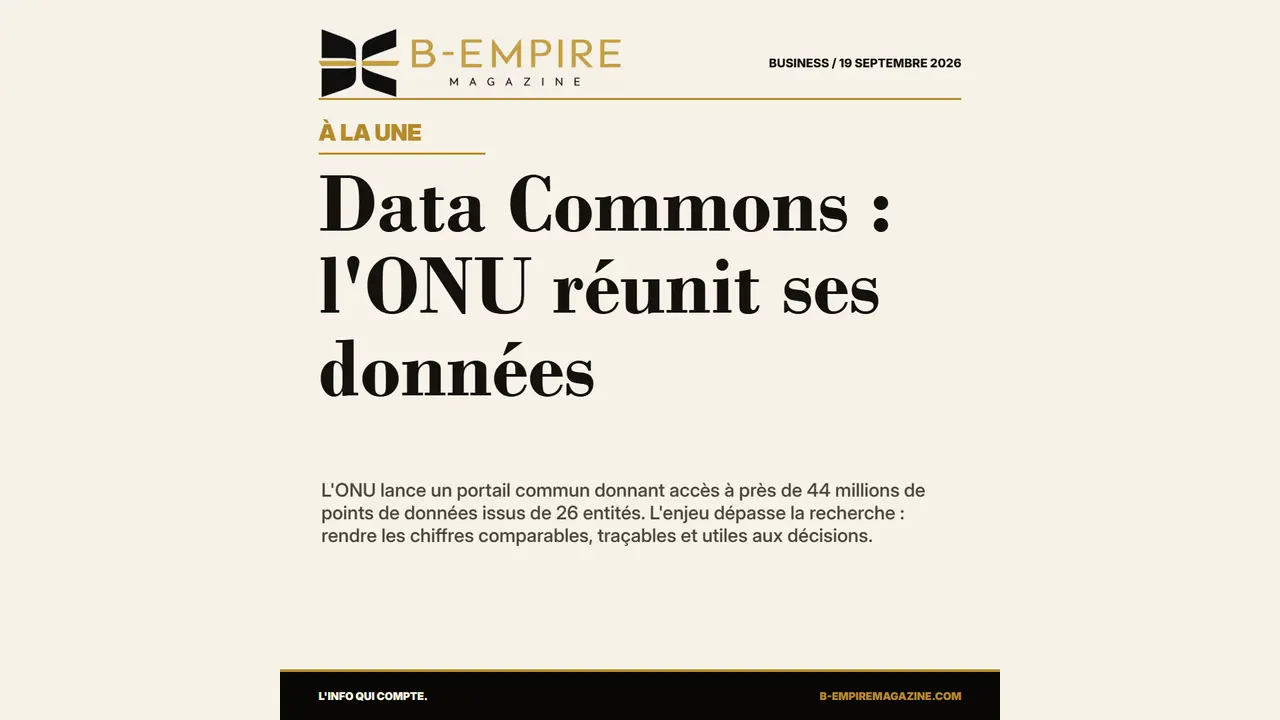
When information on health, education or climate is scattered across separate databases, the first challenge is not interpreting it: it is finding it. On September 17, 2026, the United Nations unveiled the UN System Data Commons at data.un.org. The gateway brings together public data from 26 UN system entities and makes nearly 44 million data points searchable. This technical announcement raises a practical question: can a shared route into the numbers help researchers, journalists and policymakers understand problems that do not fit neatly inside one institution’s boundaries?
A common gateway, not a single new source
The idea is to provide an entry point. The Data Commons does not replace the participating agencies’ platforms; it connects their public information in a shared space for discovery. That distinction matters. A number’s value comes not only from the site displaying it, but from the body that produced it, its method, date and limitations. The platform promises a route back to the original source. If that traceability works in everyday use, it could prevent an attractive figure from circulating without the context needed to understand it.
The UN says users can search in ordinary language, explore trends and compare topics or countries without already knowing the organization’s internal structure. For a professional preparing a note on food security and climate impacts, that could reduce the time spent locating the right databases. For a journalist, it could make a public claim easier to check. Simpler access does not, however, make every comparison valid: two series may cover different periods, definitions or territories.
Why 44 million points cannot tell the whole story
The figure of nearly 44 million data points conveys the scale of the aggregation effort, not the quality of every possible use. A large collection may contain gaps, uneven updates or series that are difficult to align. Statisticians know that an indicator is useful only when we know who was counted, under what definition and at what point in time. The gateway becomes valuable when it makes such information more visible, not merely when it returns more results. Easy search should lead to more rigorous reading, not automatic confidence.
The issue is especially clear for development goals. Decisions about water, schooling, nutrition or energy cut across sectors. A ministry may need to know whether a national improvement hides disparities among regions or population groups. An organization may want to follow the same question over time without quietly changing the definition. The Data Commons will not make these judgments on anyone’s behalf. At best, it can make the pieces of evidence easier to locate and examine together. Human judgment remains essential to interpret what they show, and what they leave out.
Public data in the age of automated answers
The launch comes as artificial intelligence tools increasingly sit between people’s questions and the underlying sources. Secretary-General António Guterres pointed to the danger that unreliable answers will fill the space left when trustworthy facts are hard to find. The portal provides interfaces through which researchers and developers can connect UN data to their own applications. That is a useful prospect: verified information can reach tools people already use. Yet a machine-generated answer does not become correct simply because it cites a respected database. The choice of indicators and the way they are combined still matter.
Traceability has practical value here. A user should be able to move from a synthesized answer to the dataset, then to its metadata and the entity responsible for it. Without that route back, an interface could add a layer of apparent authority to a weak interpretation. The participating entities’ terms of use also remain relevant: the UN says the shared gateway operates in accordance with them. Opening access does not erase every rule concerning reuse, updates or the presentation of a series.
One step in the UN80 reform effort
The project belongs to the UN80 reform initiative. In May, a progress report said 26 entities had committed to making public data available together and envisaged a later phase to modernize collection and processing jointly. The portal launched in September is therefore a visible first step, not the completion of that ambition. Connecting existing databases is useful in itself; making their methods more compatible and their updates more regular is a deeper undertaking. The report also identified interoperability, cybersecurity and data protection as essential considerations.
The benefit should be measured through use rather than volume alone. A good test would ask whether someone can find a relevant series quickly, see its provenance clearly, reproduce a comparison and have reported errors corrected. It will also matter whether people without a specialist team can use the gateway without losing statistical nuance. A common interface can lower the barrier to entry; it should not hide the limits of measurement behind a smooth presentation.
The real progress will show up in decisions
As of September 19, the Data Commons has only just launched. It would be premature to credit it with better public policies or a victory over misinformation. The immediate news is more precise: the UN has made a vast body of public data easier to discover, with cross-organization search and a promised route back to the sources. Lasting progress will depend on the quality and maintenance of the series, and on users’ ability to verify results. A portal cannot replace investigative work, but it could give that work a far better starting point.