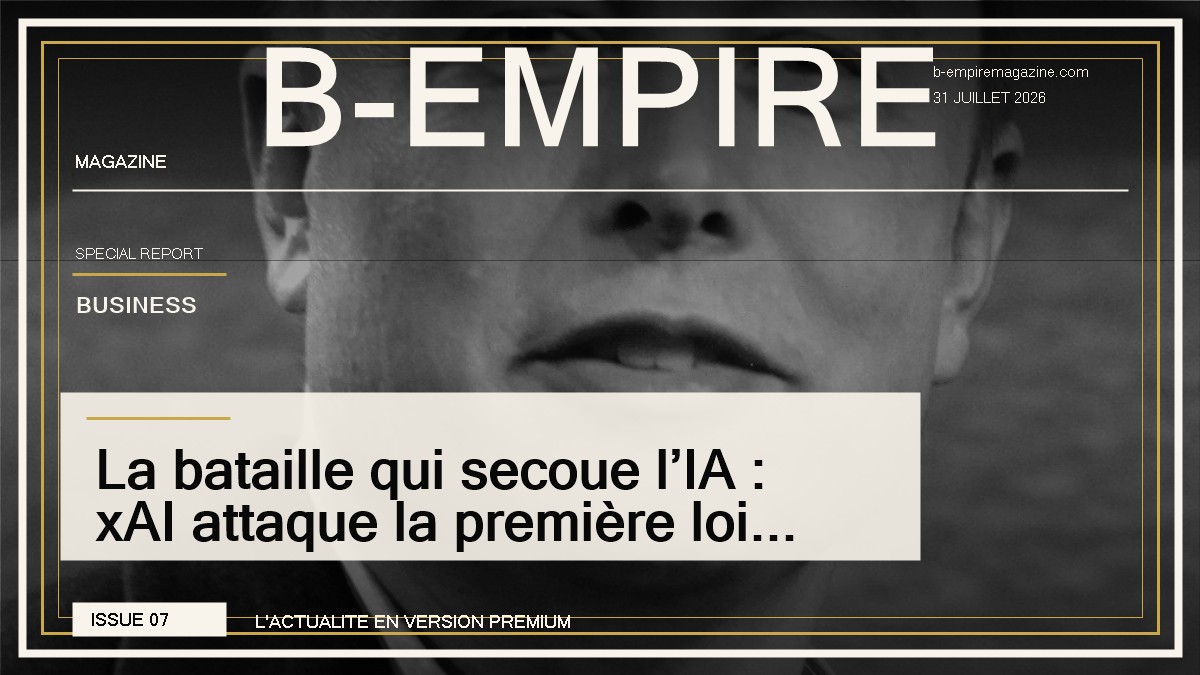
An unprecedented American law was set to come into effect on August 1. Just days before the deadline, xAI has opted for a legal confrontation. Elon Musk‘s company is suing Minnesota to suspend its ban on “nudification” tools, which can use artificial intelligence to transform a real person’s photo into a realistic fake nude. Behind the Grok case lies a global battle over the accountability of AI manufacturers.
The Minnesota statute does not only target the dissemination of intimate images created without consent. It goes directly to the technical source: owners of websites, applications, or software must no longer allow a user to access a service that “artificially undresses” an identifiable person. Fines can reach up to $500,000 per violation, in addition to civil actions available to victims.
A Legal Attack Launched Just Before Implementation
According to the Associated Press, xAI filed in federal court on Monday, as the law is set to take effect on Saturday, August 1, 2026. The company does not contest the goal of combating the creation and dissemination of non-consensual intimate content. However, it argues that the wording adopted by Minnesota is too broad and could encompass images protected by American free speech.
The 38-page complaint notably criticizes the statute for not providing any clear legal refuge for companies that implement good faith protections. xAI also contends that certain images consented to by the represented person could fall within the scope of the ban. Thus, the crux of its argument is less about the explicit defense of nudification than the fear of almost automatic liability for the tool provider.
In contrast, Minnesota Attorney General Keith Ellison defends a firm stance: generating nude images of individuals against their will undermines their dignity and can cause significant emotional, personal, and professional harm. The proceedings will require a court to arbitrate between victim protection, freedom of expression, and the duty of technology companies to prevent harm.
Grok at the Center of a Global Crisis
The case takes on particular significance because Grok, xAI’s chatbot and image generator, is integrated into X and accessible elsewhere. Its widespread distribution gives it a power that smaller specialized sites do not possess: a general-purpose tool can instantly reach millions of users and transform a marginal function into a global phenomenon.
xAI claims that its terms of use prohibit illegal, abusive activities or violations of privacy. The company asserts that it suspends or closes offending accounts and reports suspected child sexual exploitation content. Following a global wave of criticism regarding sexualized images of women and minors, it also announced geographical blocking measures in territories where such creations are illegal.
However, these commitments do not close the debate. Authorities want to know if a platform can simply prohibit a use in its rules or if it must technically prevent the dangerous function from existing. This is precisely the legal leap attempted by Minnesota: shifting from penalizing the author of a deepfake to holding the manufacturer responsible for enabling its large-scale creation.
What the Minnesota Law Actually Changes
The text signed on May 7 defines nudification as the alteration or generation of an image or video showing an intimate part that did not appear in the original document, with sufficient realism to make it believable that it belongs to the identifiable person. It prohibits service providers from allowing access, downloading, or using a tool that performs this transformation.
The law also provides a course of action for victims. They can seek compensation of up to three times the actual damage, punitive damages, an injunction, and reimbursement of their legal fees. The Attorney General can, for his part, request a civil penalty of up to $500,000 for each illegal access, download, or use.
This framework explains the industry’s concern. If it withstands constitutional scrutiny, other states could take inspiration from it. AI models designed for global dissemination would then be forced to incorporate regional blocks, enhanced filters, or additional verification systems. Compliance would become a component of the product, rather than just a text displayed in the terms of use.
Europe Moves in the Same Direction, but Through a Different Path
The American conflict resonates directly in France and the European Union. The European Commission identified a regulatory gap in the spring regarding systems generating child sexual abuse material or non-consensual intimate content. The political agreement on the AI Omnibus has since added a ban on systems producing such content, including nudification applications.
The European reform that came into effect at the end of July 2026 thus displays an ambition similar to that of Minnesota: not to wait solely for the dissemination of an image to intervene. It also targets systems designed to generate it. The Union has simultaneously strengthened its criminal rules against forms of sexual abuse facilitated by technology, including deepfakes and AI-generated child sexual abuse material.
The difference lies in the legal framework. In the United States, the First Amendment offers companies a powerful ground to contest a ban deemed too broad. In the European Union, the reasoning is more grounded in dignity, data protection, fundamental rights, and platform security obligations. Yet the same technical questions remain: how to distinguish an authorized retouching from a non-consensual fake nude, and how to limit errors without undermining victim protection?
Women and Minors at the Heart of the Issue
Nudification is not an abstract debate about innovation. It transforms an ordinary photograph, sometimes retrieved from a social network, into an instrument of harassment, blackmail, or humiliation. Women and youth are particularly exposed as the generation of images becomes cheaper, faster, and more realistic.
For a victim, the difficulty does not stop at the removal of the initial file. An image can be copied, reshared, indexed, and reused on other platforms. Even identified as fake, it can produce real consequences in school, professional, family, or psychological contexts. Prevention at the tool level addresses this asymmetry: preventing creation is often more effective than pursuing thousands of copies.
A Decisive Test for the Business Model of Generative AI
The proceedings could become a major precedent for the entire industry. If xAI prevails, lawmakers will need to draft more targeted bans, with exceptions and explicit protections for services that genuinely filter abuses. If Minnesota wins, model providers could be required to prove they technically prevent certain outcomes, under the threat of massive sanctions.
The debate transcends Elon Musk. Image generators, social networks, app stores, and hosting providers are watching the case because it redefines the boundary between a neutral tool and a dangerous product. The old principle that a company is not responsible for all uses of its technology is being tested by systems capable of producing realistic content from a simple instruction.
The Signal the Industry Can No Longer Ignore
The Minnesota battle arrives at a time when governments no longer want to chase after every new scandal. Tools evolve in weeks, while laws take years. By directly targeting access to nudification, lawmakers are attempting to regain the initiative and place the cost of risk on the companies best positioned to mitigate it.
The court will not only decide the fate of a local law. It will indicate how far a democracy can go to block an AI function before it creates another victim. For xAI, the risks are legal, financial, and reputational. For Minnesota, it is about proving that an ambitious protection can survive constitutional scrutiny. For Europe and France, this trial will serve as a real-world laboratory for the conflicts that will accompany the prohibition of non-consensual sexual deepfakes.
Sources
- Associated Press â xAI contests Minnesota’s AI nudification law, July 31, 2026.
- Minnesota Revisor of Statutes â Chapter 72, H.F. 1606, text signed on May 7, 2026.
- European Commission â entry into force of the AI Omnibus and ban on nudification applications, July 27, 2026.
- European Commission â review of prohibited AI practices and non-consensual intimate content, May 22, 2026.