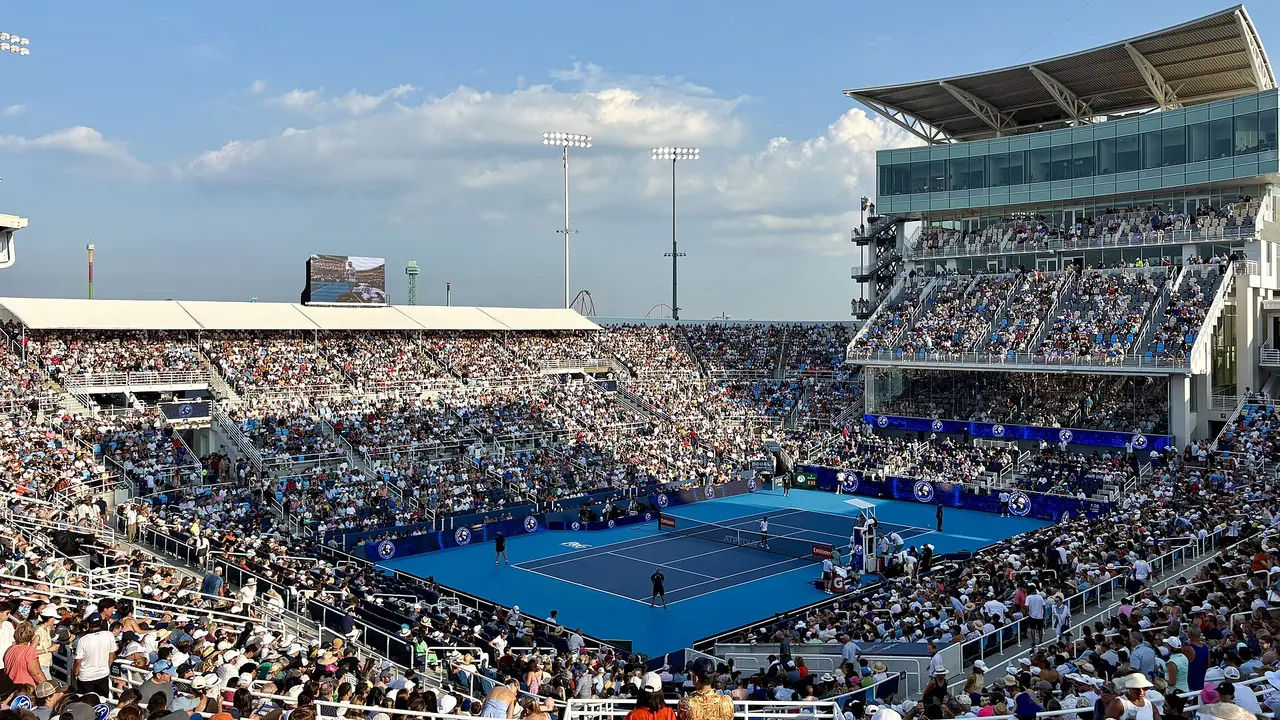
The world of tennis no longer views Cincinnati in the same light. On Tuesday, August 18, 2026, as the tournament enters its third round, the American event garners attention not only for its courts but also for its champions. Following a transformation estimated at $260 million, the Lindner Family Tennis Center has become a spectacular showcase: an expanded complex reimagined for players and fans, capable of hosting both an ATP Masters 1000 and a WTA 1000 simultaneously over nearly two weeks. What unfolds in Ohio now transcends mere preparation for the US Open.
Alexander Zverev, the headliner of the men’s draw, encapsulated the change with a powerful statement reported by Axios: the site has transformed from one of the least convincing on the circuit to probably one of the best. This judgment carries weight, as it comes from a former champion who knew the tournament before its metamorphosis. It speaks volumes about the times we live in: in professional sports, experience, infrastructure, and the ability to create a global event weigh almost as heavily as historical prestige.
A $260 Million Metamorphosis
The project, undertaken in collaboration with the city of Mason, Warren County, and the State of Ohio, has doubled the campus’s size. This expansion has allowed the Cincinnati Open to adopt draws of 96 players in singles, for both men and women, and to establish a longer format. The ATP notes that the tournament hosted the largest edition in its history in 2025 following this transformation. Players subsequently designated it the Masters 1000 of the year, a rare validation that gives the investment international significance.
The expenditure does not merely finance concrete or additional seating. It addresses a new battle among major competitions: to offer seamless training areas, modern recovery spaces, richer dining options, simpler circulation, and closer proximity to the stars. For broadcasters, partners, and content creators, a photogenic site also produces more images, conversations, and commercial value.
A Signal That Tennis Can No Longer Ignore
Cincinnati is part of the limited circle of 1000-level tournaments that bring together the ATP and WTA circuits during the same period, alongside Madrid, Rome, Miami, and Indian Wells. This dual scheduling concentrates the best players, multiplies the matchups, and facilitates the construction of a global event. The WTA presents the event as the third-largest tennis event in the United States, with 1,000 ranking points at stake and a total financial commitment exceeding $7.4 million for its draw.
On the men’s side, the ATP boasts over $9.1 million in prize money. These amounts illustrate the power of a tournament that serves as a bridge between the North American summer tour and the US Open. Players seek points, rhythm, and benchmarks on hard courts. Brands, in turn, aim to reach an international audience during a window where tennis’s attention gradually shifts toward New York.
Why the 2026 Schedule Heightens the Tension
The official schedule places the third round on August 17 and 18, followed by the round of 16 on Wednesday, August 19, the quarterfinals on Thursday and Friday, and the semifinals on Saturday. The singles finals are scheduled for Sunday, August 23. This return to a Sunday conclusion aims to make the narrative more digestible for spectators and broadcasters, following two editions where the finals were played on Monday.
The tournament welcomed a record 285,571 spectators in 2025. Its ticket packages sold out in three days, according to the organization. This figure sheds light on the logic of the new model: extending the duration is not enough; the competition must be transformed into a destination. The audience no longer comes merely to watch a match on Center Court. They can follow training sessions, move between multiple venues, enjoy dining areas, and experience an entire day on a campus designed like a small tennis town.
A Stadium That Wants to Thrive After Match Point
One of the most revealing details concerns the post-tournament phase. Center Court is set to host college basketball games in October. Public courts, a restaurant, and regular events are also planned to extend the life of the complex. This strategy aims to avoid the trap of large sports facilities used only a few days a year. It transforms an event investment into a regional asset, with revenues and visibility potentially spread over multiple seasons.
For Cincinnati and Mason, the stakes are also territorial. A global tournament fills hotels, attracts visitors, exposes the region on television, and creates a compelling argument for partner businesses. Sports thus become an economic platform. The prestige of a Masters 1000 serves to sell a city, an experience, and an ecosystem, well beyond the results displayed on the main draw.
A Global Competition in a Pressured Market
The growth of Cincinnati comes at a time when major tournaments are all seeking to secure their place in a dense calendar. Players demand better conditions but are also concerned about long and demanding seasons. Competitions must therefore demonstrate that their expansion genuinely improves the daily lives of athletes and is not merely about adding days of ticket sales. Zverev’s compliment and the players’ vote in favor of the tournament constitute, in this context, valuable assets.
The joint presence of women and men also strengthens the editorial strength of the event. At a single site, fans can shift from an ATP star to a WTA champion. This density increases ticket value and the power of television programming. It also provides tennis with a unified stage just days before the last Grand Slam of the season.
What Cincinnati Can Change for Other Tournaments
The success of the project risks creating a new benchmark. Competing events will be compared based on the quality of locker rooms, training courts, fan services, and commercial spaces. Not all cities can invest $260 million, but all will need to explain how they enhance the experience. Cincinnati demonstrates that the history of a century-old tournament no longer solely protects its position.
This transformation, however, comes with a requirement: to remain accessible. Premium offerings, restaurants, and partner spaces enhance profitability, but tennis must also retain entry points for families and new audiences. The organization has offered qualifying tickets starting at eight dollars and discounts for children. This blend of prestige and accessibility will be one of the most important tests of the model.
The World Now Looks to Ohio
As the round of 16 approaches, results will naturally take center stage. A surprise, a spectacular duel, or the fall of a seed can change the conversation in minutes. However, the most enduring narrative of the Cincinnati Open 2026 is already visible: a historic tournament has leveraged a massive investment to change dimensions and convince the players themselves.
If this edition confirms the momentum of the record attendance in 2025, Cincinnati will no longer be merely an important stop before the US Open. The tournament will become proof that a city can redraw its place on the global sports map by combining competition, spectacle, infrastructure, and local life. The $260 million have built a campus. They have primarily launched a message that other major tennis capitals cannot ignore.
Sources
- Axios, August 18, 2026: Alexander Zverev’s reaction and the use of the complex after the tournament.
- Cincinnati Open: 2026 schedule, 2025 attendance, and campus transformation.
- ATP Tour: Masters 1000 status, prize money, and tournament features.
- WTA: WTA 1000 status, draw, and prize money.