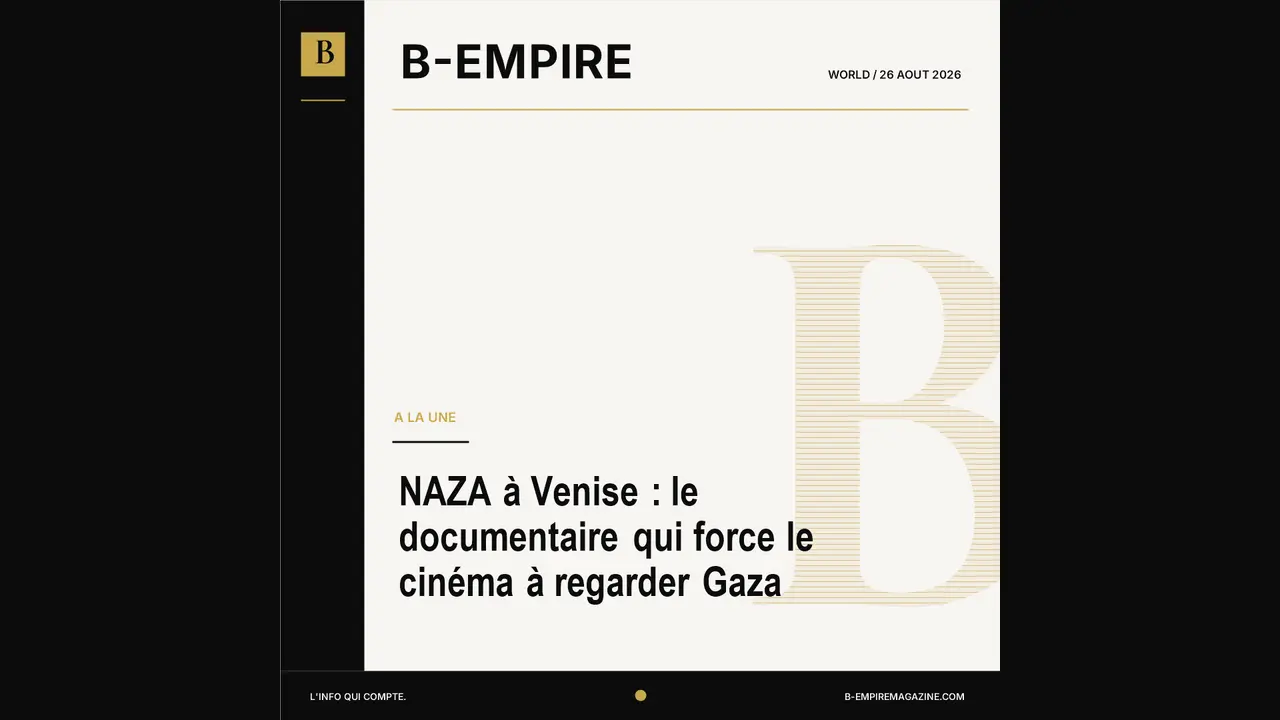
The Venice Film Festival has just added a film that immediately changes the temperature of its 83rd edition. NAZA, a documentary directed by Yuval Abraham and Rachel Szor, will enter the official competition and screen on the Lido on September 10, 2026. The gesture carries rare symbolic force: the world’s oldest film festival is placing a political documentary at the heart of the race for the Golden Lion, signed by two Israeli filmmakers already connected to the Oscar won by No Other Land.
This is not merely a programming announcement. It is a curatorial risk. Venice already welcomes major auteurs, stars, studios, platforms, and films expected as industrial events. By inserting NAZA into that landscape, La Biennale reminds us that festival cinema is not only a factory of glamour: it can also become a place where images challenge the official version of the world.
A Documentary in the Golden Lion Arena
According to the official announcement from La Biennale di Venezia, NAZA completes the competition section of the 83rd Venice Film Festival, which runs from September 2 to 12, 2026. The 80-minute film is directed by Yuval Abraham and Rachel Szor, produced by The Guardian and James Wilson, with Jonathan Glazer as executive producer. It is scheduled to screen in the Sala Grande on September 10 at 5:15 p.m., in the presence of the directors, producers, Guardian journalists, and the official delegation.
The synopsis published by the festival presents a work shot at night on the rooftops of Tel Aviv and focused on systems that allegedly framed Israeli strikes against Palestinian civilians in Gaza. The wording is heavy, and it demands careful reading: the film carries an investigation, a documentary accusation, an artistic point of view, and a journalistic claim. It is precisely this friction between evidence, narrative, staging, and controversy that may make NAZA one of the most debated titles of Venice 2026.
After No Other Land
Yuval Abraham and Rachel Szor are not arriving on the Lido as unknown names. They were part of the four-filmmaker collective behind No Other Land, the documentary that won an Oscar in 2025, alongside Basel Adra and Hamdan Ballal. That film had already positioned their work in a zone where art, reporting, activism, and international politics become inseparable. NAZA extends that path through another form: less the long observation of a territory than a focused investigation into mechanisms of decision-making.
The Guardian’s role as producer strengthens that dimension. The documentary is presented as an extension of investigations published between 2023 and 2025 by +972 Magazine, Local Call, and The Guardian. In an audiovisual market where platforms often seek instantly consumable narratives, NAZA instead asserts a more frontal method: start from the investigation, bring the dossier to the screen, and then expose that material inside the prestigious and vulnerable space of a major festival.
Venice as Cinema Stage and Symbolic Courtroom
A festival is not a court. It does not replace judicial investigation, the work of international institutions, or political adversarial debate. But festivals produce something else: concentrated attention. In a matter of days, a work can be seen by programmers, distributors, journalists, artists, platforms, and cultural decision-makers. In the case of a documentary like NAZA, that attention has strategic value.
Venice knows this programming choice will be read as a signal. The festival has already been crossed by debates over war, artists’ responsibility, and the power of images. The addition of NAZA, the only documentary in competition according to elements reported by AP, turns this edition into a global echo chamber for a question many cultural institutions dread: how can contemporary violence be shown without simply turning it into spectacle?
The Fragile Power of Documentary
Political documentary occupies a paradoxical place. It is often less financed, less distributed, and less commercially protected than fiction. Yet when it lands with precision, it can shift opinion more durably than a blockbuster. Its strength comes from its promise: to show what has been ignored, classified, hidden, or made abstract by distance. Its weakness comes from the same place: every editing choice, every absence, every sentence in a synopsis immediately becomes contestable.
NAZA therefore enters a territory where precision will be decisive. Audiences will not judge only the beauty of the shots or the dramatic efficiency. They will examine the solidity of the sources, the clarity of the argument, the place given to victims, and the way institutional speech is represented or absent. Cinema is not enough by itself when it claims to reveal a system. It must also make its method felt.
An Industrial Question for The Guardian
For The Guardian, NAZA is not simply a brand extension. It is a way of asserting that investigative journalism can live through cinema without losing its rigor or identity. The presence of James Wilson and Jonathan Glazer, associated with The Zone of Interest, gives the project strong symbolic architecture: a news organization, Oscar-winning documentarians, and a team already recognized for exploring, through cinema, the administrative banality of violence.
This kind of alliance is becoming increasingly important. Newsrooms are looking for new formats to circulate their investigations. Festivals are looking for works that can exist in public debate beyond cinephile criticism. Distributors are watching whether such a charged documentary can become an international object without being reduced to its subject. NAZA sits exactly at that intersection: information, cinema, prestige, risk.
Why This Selection Matters
The arrival of NAZA in the competition reminds us of a simple truth: major festivals do not merely consecrate films, they also organize the global conversation around them. In 2026, a political work does not circulate only in theaters. It moves through social networks, statements, opinion pieces, artists’ positions, platform decisions, and diplomatic reactions. Each screening can become a media event of its own.
Venice’s responsibility will therefore be double. On one hand, it must protect the artistic space required by an investigative film. On the other, it must avoid letting controversy crush the cinematic reception. NAZA will have to be watched as a work, questioned as a document, and discussed as a public act. Few films ask for so many readings at once.
The Lido Faces Reality
The Mostra loves red-carpet images, gowns, flashes, and the return of major auteurs. But its history has always been crossed by political reality. NAZA belongs to that less comfortable lineage. It arrives in Venice with the force of a burning subject, but also with a broader question for contemporary cinema: what can an image still do when the world is saturated with images of war?
The answer will not come from a press release. It will unfold in the theater on September 10, when audiences discover whether NAZA can transform investigation into a cinematic experience. If the film fulfills its promise, it will not simply be a late addition to the program. It may become one of the gravitational points of Venice 2026, where the spectacle industry agrees, for a moment, to look directly at what exceeds it.
Sources
- La Biennale di Venezia — NAZA added to the program, August 24, 2026.
- La Biennale di Venezia — public screening page for NAZA, consulted on August 26, 2026.
- Associated Press — Venice Film Festival adds Gaza doc NAZA to competition lineup, August 25, 2026.
- The Guardian — NAZA production announcement, August 24, 2026.