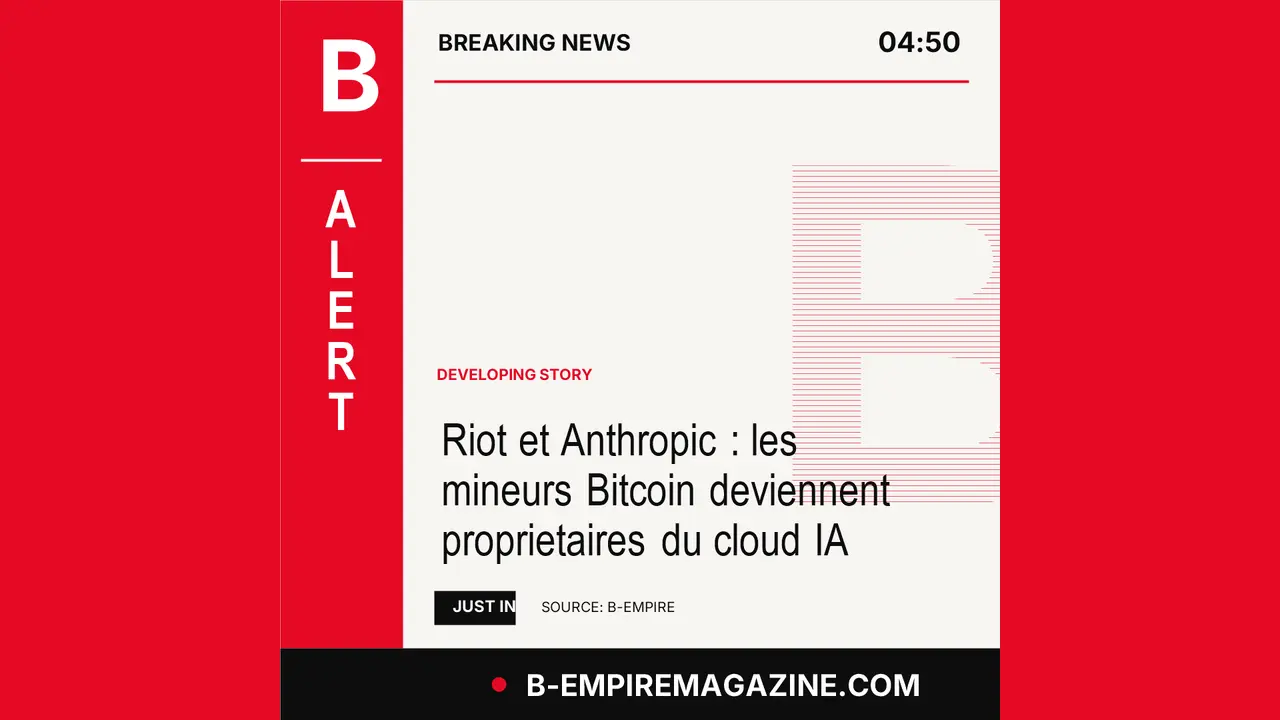
Riot Platforms has signed the kind of contract that turns an old crypto story into central artificial intelligence infrastructure: a $9.1 billion, 20-year agreement with Anthropic to provide 191 megawatts of compute capacity from its Rockdale, Texas site. The signal is clear: Bitcoin miners are no longer selling only hash. They are selling organized electricity, buildings, timelines and compute.
Investopedia reports that Riot’s stock rose after the announcement, supported by the capacity contract with Anthropic and by quarterly results that already show more than $20 million in data center-related revenue. Barron’s describes the agreement as a turning point for Bitcoin miners, with a value that could reach $16.1 billion if certain extensions materialize. For B-EMPIRE, this story matters because it tells a shift: the old speculative economy of mining is becoming a physical economy of AI cloud.
From mining to infrastructure contract
Riot is not starting from zero. Its official site presents a platform built around three pillars: data centers, Bitcoin mining and engineering. The group claims 2 gigawatts of approved power pipeline, more than 1,300 controlled acres and operating sites in Texas and Kentucky. That base explains why AI players are looking at former miners with interest. They already own what cloud startups desperately need: energy, land, grid connections, operating experience and a culture of extreme electrical loads.
Bitcoin mining installed a brutal discipline: find the cheapest electricity, deploy quickly, cool heavily and optimize every watt. AI requires a more institutional version of that skill. Customers do not want only a warehouse full of machines. They want contractual commitments, service quality, secure architectures, credible timelines and the ability to speak to investors as well as local regulators.
Why Anthropic is looking at Rockdale
Anthropic has become one of the central names in the race for AI models. Its Claude products consume massive amounts of compute, and the company has already multiplied infrastructure partnerships, including with Google and Broadcom for multiple gigawatts of next-generation capacity. The Riot agreement fits that logic: diversify paths to compute, secure megawatts, reduce bottlenecks and support demand that is not slowing.
Rockdale therefore becomes more than a former mining territory. It is an industrial option for an AI company that must turn software growth into physical capacity. Models can be improved by researchers; customers can arrive through APIs; but the commercial promise holds only if infrastructure follows. In this world, a 20-year contract is not a simple supply line. It is insurance against scarcity.
AMD as the first proof
Riot had already begun its shift with AMD. In its first-quarter 2026 results, the company said it had recognized its data center activity as a separate segment and highlighted capacity expansion tied to AMD. SEC documents show data center revenue linked to initial leasing and fit-out services, proof that the transition was not only narrative. Anthropic therefore arrives after a first industrial validation.
That matters to investors. Many companies announce AI projects; fewer deliver capacity on time, with identifiable customers and visible revenue. Riot still has to prove that the Anthropic scale can be executed without slippage, but the contract changes the equity story. The market is no longer looking only at the price of Bitcoin. It is watching Riot’s ability to own a piece of the AI supply chain.
The risk of a new energy dependence
This conversion does not erase political questions. AI data centers already raise debates about water, electricity, emissions, noise, local grids and competition with residential or industrial needs. When a Bitcoin miner becomes an AI supplier, it changes legitimacy, but it does not change the physical nature of the problem. Energy still has to be produced, transported, converted and cooled at large scale.
Riot tries to frame that question by speaking about an energy platform and digital infrastructure. In May, the group even announced a collaboration with Terrestrial Energy around data center projects that could be powered by advanced nuclear. That direction says something about the era: AI is forcing technology companies to look for solutions that resemble industrial policy more than software.
What Bitcoin miners have understood
The Riot-Anthropic deal belongs to a wider trend. Several former miners are trying to convert their energy advantage into a cloud advantage. The logic is simple: mining is cyclical, exposed to the Bitcoin price and to halvings; AI promises long contracts, corporate customers and a valuation closer to critical infrastructure. The same megawatt can therefore change financial status depending on what it powers.
But the conversion is not automatic. AI compute requires more reliability, more density, more networking, more standards and deeper customer relationships than mining. The winners will not simply be those that own electricity. They will be those that can turn that electricity into a reliable, financed, auditable service compatible with the demands of the largest AI labs.
Why this story matters
The agreement between Riot and Anthropic matters because it shows how two narrative bubbles can meet: crypto yesterday, AI today. The difference this time is that the contract rests on very concrete assets: power, sites, machines, customers, revenue, construction and timelines. Value is not coming only from a token or a model promise. It is coming from the ability to deliver infrastructure everyone wants and few actors can build quickly enough.
For B-EMPIRE, it is a business lesson: the forgotten infrastructure of one trend can become the foundation of the next. Bitcoin miners were criticized for their energy consumption. The same assets are now coveted pieces in the AI race. The digital world changes vocabulary, but its deepest need remains the same: current, space and execution without delay.
Sources
- Investopedia – Riot Platforms and Anthropic 9.1 billion dollar compute deal
- Barron’s – why the Anthropic-Riot deal matters for Bitcoin miners
- Riot Platforms – digital infrastructure platform overview
- Riot Platforms – collaboration with Terrestrial Energy on nuclear-powered data centers
- SEC filing – Riot first-quarter 2026 financial results and data center transition
- Anthropic – Google and Broadcom next-generation compute partnership