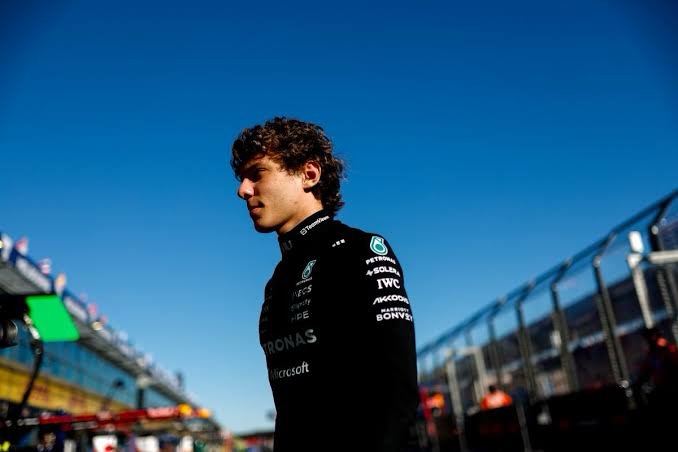
The setting was perfect for a moment of British nostalgia. It turned into a statement of power from a new generation. This Saturday, July 4, 2026, at Silverstone, Kimi Antonelli won the British Grand Prix sprint ahead of Lewis Hamilton and Lando Norris. On paper, it was just a short race. In reality, it was a much bigger signal: world Formula 1 is entering a phase where the prestige of historic icons is no longer enough to contain the political, sporting and symbolic speed of new faces.
Formula 1’s official report published July 4, 2026 is clear: Antonelli claimed his first sprint win at Silverstone ahead of Hamilton and Norris. Meanwhile, The Guardian described a hard-fought race in which Hamilton, starting in front of his home crowd, held the lead before yielding to the Mercedes driver’s pace. Together, these two accounts explain why the story goes well beyond the raw result. Silverstone is one of F1’s great emotional theatres. Beating Hamilton here, on a weekend when Ferrari sought the ideal showcase, changes the tone of the entire championship.
Why this sprint win matters far more than a good Saturday
In classic F1 reading, a sprint can be treated as a side note, a bonus, a prelude to the real Grand Prix. That would be a mistake here. Because the fixture brought together several global power lines at once: Antonelli’s rise, Hamilton’s attempted reconquest under Ferrari colours, McLaren’s pressure with Norris, and Silverstone’s intact centrality in the sport’s commercial imagination. When a young driver manages to break such a perfect script for a local legend, it says something deep about the state of power in F1.
Hamilton had everything to produce the ideal image of the weekend: the crowd, the circuit, the experience, the Ferrari narrative, the prospect of a new historic home moment. But Antonelli turned that staging into its opposite. He showed that 2026 F1 is no longer just a championship where old masters extend their influence. It’s a championship where an already very fast driver is becoming, race after race, a global centre of gravity.
Antonelli isn’t just winning a race, he’s winning a status
The strength of a win like this lies in its context. Silverstone isn’t a neutral circuit in the paddock’s emotional hierarchy. It’s a place of memory, business, global broadcast and media validation. Winning at Silverstone, even in a sprint, never carries quite the same value as elsewhere. Beating Hamilton there adds another symbolic layer. It doesn’t mean the Briton has stopped being dangerous. It means Antonelli already knows how to win against the championship’s heaviest symbols.
The Guardian’s report stresses that Hamilton gave the crowd plenty to believe in for a long time before Antonelli let his Mercedes’ superior pace do the talking. This detail matters. This isn’t a chaotic start, a lucky strategy, or an incident. It’s a power grab on track. For Antonelli’s image, that’s crucial. The world’s great drivers don’t just accumulate points: they impose memorable scenes where they take something from someone. Here, Antonelli took from Hamilton a moment that seemed almost written for him.
Silverstone also reveals Ferrari’s new fragility
There’s another, equally interesting reading on the Ferrari side. Seeing Hamilton finish second in front of his home crowd isn’t a catastrophe. On the contrary, it shows signs of competitiveness. But the feeling of the day isn’t Ferrari’s resistance. It’s the inability to convert an ideal scenario into victory. And in F1, great teams are judged exactly on that: turning emotionally perfect occasions into concrete dominance.
For Ferrari, the image is therefore ambivalent. On one hand, the Scuderia keeps placing itself at the centre of the global story thanks to Hamilton. On the other, it remains exposed to a simple question: can it really regain sporting control of the championship when Mercedes fields a driver this young, this cold and already this decisive in high-symbolism moments? Silverstone’s sprint doesn’t settle the whole season, but it sharpens that tension.
A younger, faster, more global F1
Antonelli’s case goes beyond his duel with Hamilton on the day. What he embodies is very contemporary: a younger F1, more aggressive in its renewal, and increasingly readable as a global product. The sport doesn’t just sell cars and results. It sells human trajectories, generational shifts, clashes between heritage and acceleration. Antonelli ticks every one of these boxes. He’s young, media-friendly, already high-performing, and composed enough to make his wins look like normal milestones rather than miracles.
That’s also why this race can resonate well beyond F1’s traditional audience. For Google Discover, social media and the general press, a story like this is far more powerful than a simple points table. It tells of a visible power shift in a matter of laps: the hoped-for hero of the day is denied a perfect triumph by the one who already embodies what comes next. F1 loves this kind of drama, and so does the global sports business.
The British crowd, Hamilton and the brutality of modern sport
It’s also worth looking at what this finish says about modern sport. Silverstone’s crowd obviously wanted to believe in a Hamilton sprint win. The combination of name, place and history offered an almost cinematic intensity. But it’s precisely in this kind of setting that new leaders take up the most space. They don’t win in the shadows. They win against the heaviest collective expectation.
This may seem cruel for Hamilton, but that’s how great transitions are written. The legend doesn’t disappear. He becomes the backdrop against which the next generation measures itself. By finishing ahead of him, Antonelli didn’t just take points. He took symbolic ground at one of the calendar’s most charged venues. At this level, F1 works like the great cultural industries: it needs champions, but it also needs images of brutal handover to keep global desire for the product alive.
What this sprint changes for the rest of the weekend and season
It’s worth staying rigorous: a sprint isn’t Sunday’s Grand Prix. The weekend isn’t over, and the season even less so. But the narrative effect is already there. Antonelli goes into the main race with reinforced authority. Hamilton still has a solid case that Ferrari is in the fight, but he no longer holds a monopoly on emotional momentum. Norris, third, reminds everyone that McLaren is never far off and that the fight at the front isn’t a simple two-way duel.
For the championship, this kind of episode mainly cements an idea: 2026 won’t just be a season of prestige. It will be a season of redistribution. The historic names remain huge, but they no longer control the weekend’s image with the same ease. Antonelli embodies that redistribution as visibly as possible. He wins, he calms the crowd without silencing it, and he imposes the idea that F1’s future won’t politely wait for the symbols of the past to finish their victory lap.
A perfect story for B-EMPIRE Magazine
Editorially, this Silverstone sprint ticks everything B-EMPIRE looks for in a great global story: sport, spectacle, a power shift, a historic star, a new leader, and a powerful image that speaks instantly. This isn’t a simple results sheet. It’s a story of accelerated succession in one of the most global championships on the planet. And it’s also a broadly European story, since Silverstone remains a symbolic centre of continental sports business, with Ferrari, Mercedes and McLaren at the heart of the narrative.
The real lesson of this Saturday, July 4, 2026 is therefore simple. Hamilton hasn’t disappeared. Ferrari hasn’t sunk. But Antonelli has imposed something more precious than a statistic: he has imposed an obvious truth. When a young driver takes Silverstone away from a seven-time champion in front of his own crowd, the question is no longer whether he already belongs at the top. The question becomes who, this season, is still capable of slowing down this new era.