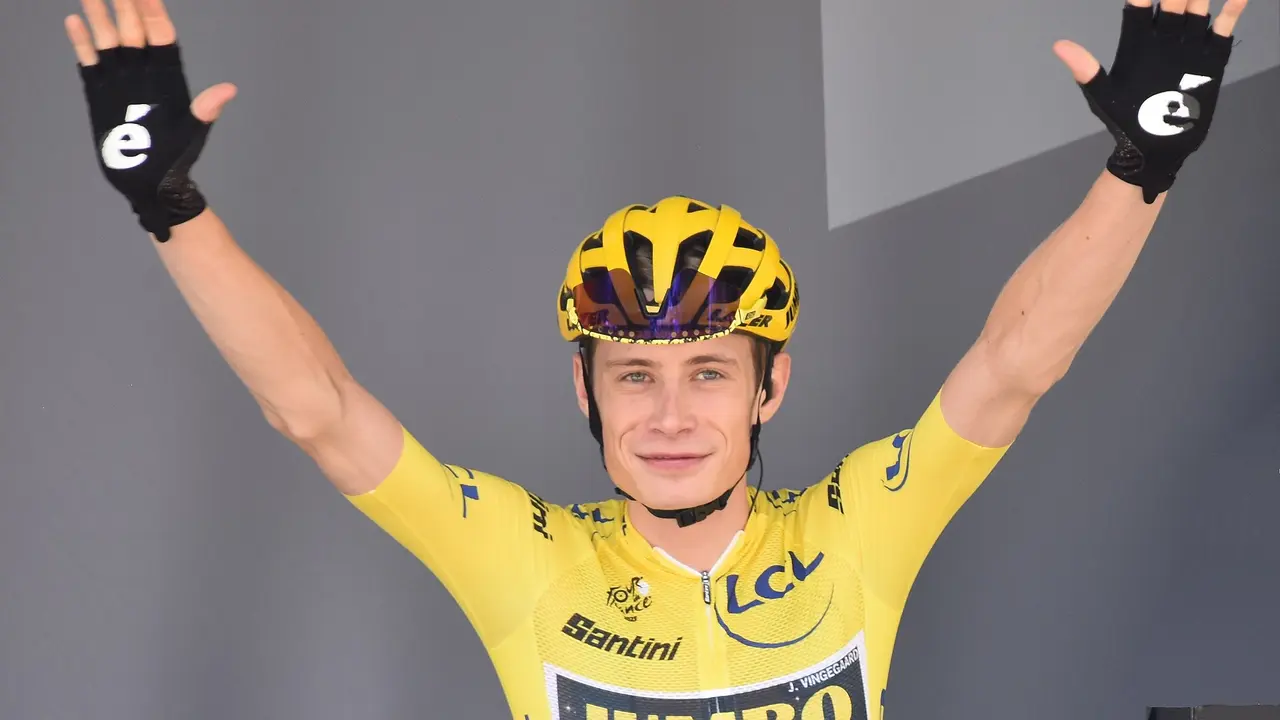
The 2026 Tour de France chose to strike fast. This Saturday, July 4, 2026, in Barcelona, Jonas Vingegaard didn’t just get his Grande Boucle off to a good start: he seized the yellow jersey on stage one and sent a brutal message to the entire race. In a 19.6 km team time trial with a new format, the Visma-Lease a Bike squad flipped the expected script and placed the Dane at the centre of the global storyline. For B-EMPIRE Magazine, the story is ideal: a planet-wide event, a deeply French sporting heritage, and a genuine first shock that could already reshape July’s narrative.
The latest reports converge clearly. The Guardian reported on July 4, 2026 that Visma-Lease a Bike won the opening stage in 21 min 47 s, with Jonas Vingegaard in yellow, 8 seconds ahead of Netcompany Ineos and 12 seconds ahead of UAE Team Emirates-XRG. The same paper’s live coverage confirms the main gaps and the new jersey standings, with Tadej Pogacar in polka dots, Egan Bernal in green and Juan Ayuso in white. Bicycling also published stage 1 results this Saturday, placing Vingegaard ahead of Filippo Ganna and Pogacar in the provisional general classification. In short, there’s no debate about the day’s headline fact: the Tour already has a visual boss, and that boss is named Vingegaard.
A first stage, but already a first blow
One could have imagined a spectacular opener in Barcelona. What wasn’t necessarily expected was such a symbolic power grab. The new team time trial format was supposed to bring a bit more uncertainty, a bit less collective lockdown, and a more individual reading of performance. That’s exactly what it produced. Instead of a simple leg-loosening exercise, stage 1 immediately redistributed the pressure. Vingegaard obviously doesn’t win the Tour in July on day one. But he takes back control of the race’s imagination, and that matters enormously in a rivalry of this calibre with Pogacar.
The signal is powerful because it touches several circles at once. For enthusiasts, this result validates Visma’s hyper-targeted preparation. For the general public, it produces a very simple image to remember: Pogacar’s direct rival comes out on top of the first battle. And for the world of sport, it’s a reminder that a modern Tour de France now has to produce drama immediately, without waiting for the Alps or the Pyrenees. Barcelona played that role to perfection.
Why this yellow jersey already changes the pressure on Pogacar
The real stakes aren’t just the day’s time. They’re mental, narrative and tactical. Tadej Pogacar isn’t out of touch, far from it. Twelve seconds, over three weeks, represent nothing irreversible. But twelve seconds taken by Vingegaard in a Grand Depart this media-exposed are worth far more than a raw number. They raise an immediate question: is the Slovenian arriving at the 2026 Tour as the hunter rather than the boss? In a duel this closely watched, that shift in perception feeds the entire global coverage.
The Guardian’s live coverage also shows that the new rule served this battle of individuals perfectly. Teams could sacrifice more teammates to launch their leader on the final stretch toward Montjuic. Visma executed it better. Vingegaard was able to finish the job at the key moment and convert the collective effort into personal dominance. That’s the very definition of a credible first warning. Not a publicity stunt. Not a quirky surprise. A warning of high sporting value.
The France angle exists, and it’s far from secondary
The Tour de France remains a global stage, but its symbolic heart stays French. Every powerful early image of the Tour resonates immediately across France. And Barcelona’s opening day didn’t just talk about Vingegaard and Pogacar. It also offered a clear France angle. Paul Seixas, closely watched before the start, made his entrance into the Grande Boucle in a highly visible stage. The Guardian’s live blog places him in a decent, if unspectacular, start to the Tour — already useful information: the hype around the young Frenchman remains intact, but the terrain immediately reminds everyone of the toughness of the world-class level.
There was also the bad luck of Kevin Vauquelin, a puncture victim according to The Guardian’s account just as Netcompany Ineos seemed poised to push even higher. For a French-speaking reader, this detail matters. It adds national tension to an already international stage. France didn’t just watch the Vingegaard-Pogacar duel. It also saw its own storylines emerge in the same setting: that of prodigy Seixas and that of Vauquelin, punished at the worst possible moment.
Barcelona turns the Tour into an instant global product
A Grand Depart outside France is no longer an anomaly. It has become a visibility accelerator. Cyclingnews noted the day before that this Barcelona opener was designed as an immediate battle for the first yellow jersey, with a technical urban route followed by a selective finish toward Montjuic. That’s exactly what happened. The city gave the Tour a hugely shareable setting: grand avenues, heat, monuments, speed, corners and an uphill finish. In 2026, that’s a perfect grammar for television, social media and Google Discover.
This point matters for B-EMPIRE Magazine’s editorial line. We’re not after a simple niche recap. We’re after the moment a global event tips into the general conversation. Today, the Tour met that condition. Stage one delivered a result, a premium duel, French tension, a highly visual setting, and already a promise for what’s next. Few sports stories of the day tick this many boxes at once.
Context makes the win even heavier
The Guardian’s piece adds another layer: the race is already unfolding against a backdrop of intense heat and heightened vigilance over wildfires in northern Catalonia and around the Mediterranean rim. This backdrop doesn’t replace the sporting analysis, but it amplifies it. The 2026 Tour isn’t starting in a bubble. It’s starting in a European summer under strain, with climate news itself becoming a character in the spectacle. That gives even more weight to Vingegaard’s first show of force: his team executed flawlessly in an already tense environment.
By reasonable inference from the sources, this setup makes the road ahead even trickier for the favourites. The slightest logistical weakness, the slightest mismanagement of effort, or the smallest mechanical incident can matter more in a packed first week. Today, Visma looked like a very clean machine. That’s exactly the image Pogacar and the others would have preferred to avoid on the evening of stage 1.
What the Tour already says about the month of July
It’s worth staying rigorous: the Tour isn’t won on July 4. But it can start being told on that day, and that’s exactly what just happened. Vingegaard reclaims a central position in cycling’s global narrative. Pogacar finds himself, even if only slightly, in a more reactive posture. France keeps two very useful storylines with Seixas and Vauquelin. And the global public immediately understands this won’t be a slow-burning edition. The 2026 Tour has chosen immediate intensity.
Tomorrow’s 168.5 km route between Tarragona and Barcelona, already billed as more nervous in its finale, could still reshuffle impressions. But today’s snapshot will remain. At the start line, everyone was talking about the new rule, Barcelona, the return of the team time trial and the tech war. At the finish line, one simple fact overshadows everything else: Jonas Vingegaard took the yellow jersey. And in a Tour that wants to exist everywhere, right away, that kind of image is already worth gold.
The signal nobody can ignore
Today’s signal is crystal clear: the 2026 Tour de France didn’t open with a formality, but with a first battle won by Vingegaard. This yellow jersey taken in Barcelona settles nothing definitively, but it hands narrative advantage, confidence and pressure to one of the two men expected to dominate July. For France, the stage also confirms that the Grande Boucle remains a national theatre with global reach, capable of producing, within the same hour, a Danish champion, a Slovenian rival, a promising young Frenchman, and a cruel incident for Vauquelin.
The sporting world was looking for a first shock. It already has one. And it’s wearing a yellow jersey.