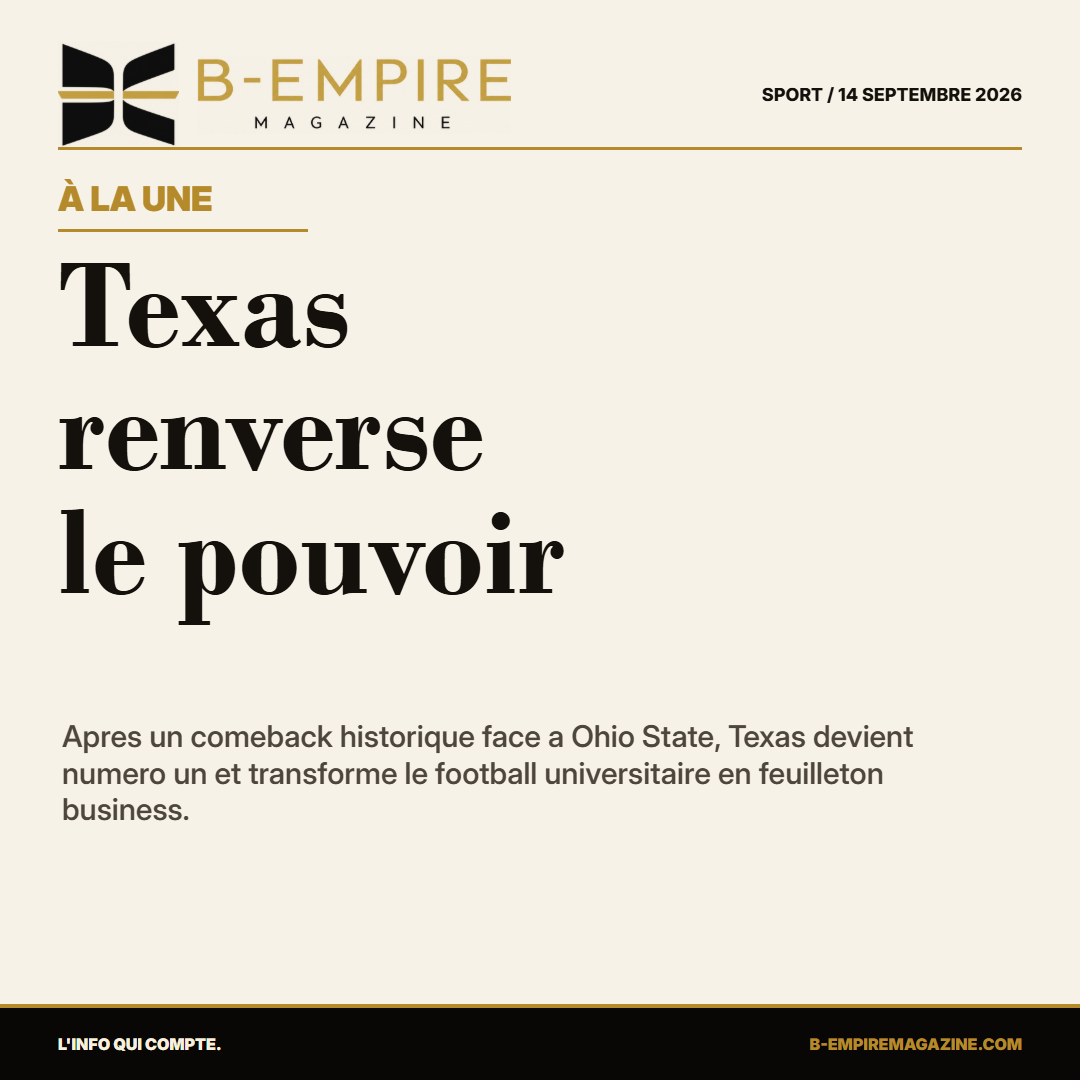
American college football has just changed its center of gravity: Texas has climbed to No. 1 in the AP Top 25 after a comeback that already feels cinematic. On Saturday night in Austin, the Longhorns erased a 20-point fourth-quarter deficit to beat Ohio State 24-23. The next day, the Associated Press placed them at No. 1. On the field, it was a feat. Economically, it was an accelerator.
AP notes that Texas had not held the top spot during the regular season since October 2024, and that such an early rise reaches even deeper into the program’s memory. The win over Ohio State did more than move votes. It created a national narrative: Arch Manning as a quarterback able to survive chaos, Steve Sarkisian as the architect, Austin as the temporary capital of Saturday night, and the SEC as a machine of media dominance.
The Comeback as Cultural Product
In modern sport, a score no longer lives alone. It becomes video clip, studio debate, newsletter subject, recruiting argument, platform fuel and signal for sponsors. Texas’ rally has every ingredient of a viral product: a historic team, a No. 1 opponent, an almost fatal deficit, a quarterback with an already mythic name and a finish that lives in a few seconds.
AP reported that Texas trailed 23-3 before coming back, with the final sequence ending on a Hollywood Smothers touchdown with 25 seconds left. Arch Manning, after a difficult start, found Ryan Wingo to revive the game and finished with 196 passing yards. That detail matters: the public is not only buying the win. It is buying the idea that an heir can wobble, then regain control at the exact moment the camera is waiting for a character.
Arch Manning, Sporting and Narrative Asset
The Manning name turns every action into national content. Arch is not an ordinary quarterback: he carries a genealogy, an expectation, a commercial pressure and a curiosity that go far beyond campus. Every mistake becomes conversation, every conversion becomes symbol. That status can be heavy, but it is extremely valuable for a university, a conference and broadcasters.
This is where the story becomes B-EMPIRE. Texas is not only selling football. Texas is selling a brand, a city, a stadium economy, media rights, a clothing line, a recruiting promise and a stage for platforms. When Manning produces a comeback like this against Ohio State, he does not merely win a game. He increases the attention value of everything around him.
The SEC Expands Its Territory Again
The new hierarchy also strengthens the SEC’s weight. According to AP, the conference has nine teams in the Top 25, including six in the Top 10. In an industry where broadcast rights structure power, that density becomes a weapon. The more the SEC concentrates decisive games, the more it concentrates television appointments, sports betting, social conversation and indirect revenue.
The shift is even more dramatic because Oregon falls sharply after losing to Oklahoma State, while Michigan returns to the ranking and Ohio State drops to No. 6. College football loves these shocks because they create permanent drama. Nothing is stable, so everything remains negotiable: playoff places, premium matchups, audiences and the perception of each conference.
ESPN Had Already Built the Spectacle
The game had been programmed as an event before kickoff. ESPN brought College GameDay to Austin for the matchup between No. 1 Ohio State and No. 4 Texas, with distribution across ESPN, ESPNU, Disney+ and the ESPN App. The network also framed the week as a major slate, with 88 games and 13 ranked teams across its platforms.
That architecture is essential. College sport is no longer only local or regional competition. It is a factory of national programming. Campuses become sets, students become living scenery, coaches become recurring characters, and rankings become episodes. When the game then delivers a historic comeback, the whole media machine can recycle the story for days.
The Ranking as Attention Market
The AP Top 25 almost works like a symbolic stock exchange. A win does not only deliver points: it moves trust. Texas rises, Ohio State falls, Oregon loses aura, Michigan returns to the frame, and each movement changes the narrative price of upcoming games. For fans, it is a ranking. For brands, broadcasters and recruiters, it is a value map.
The next effect will depend on Texas’ ability to turn this moment into cadence. A comeback gives an image. A season gives domination. The difference between the two will be measured in the coming weeks: advertising, tickets, merchandising, audiences, high school recruiting, NIL, alumni confidence and political weight in conference discussions.
Why the Signal Goes Beyond Austin
For B-EMPIRE, the interest lies in this fusion of sport, media and business. Texas shows how a university can become an attention empire in one night, if it has the history, the stadium, the quarterback and the broadcaster. American college football can be hard to understand from the outside, but it says a lot about global sport: clubs, leagues and federations all want to turn matches into continuous narrative appointments.
The reversal against Ohio State may remain the first great chapter of the season. Or it may become an early flare that the rest of the season puts into perspective. But on September 14, 2026, the signal is clear: Texas has taken back sporting power, Arch Manning has recovered the center of the conversation, and the SEC once again owns the most valuable raw material in modern sport, collective attention.