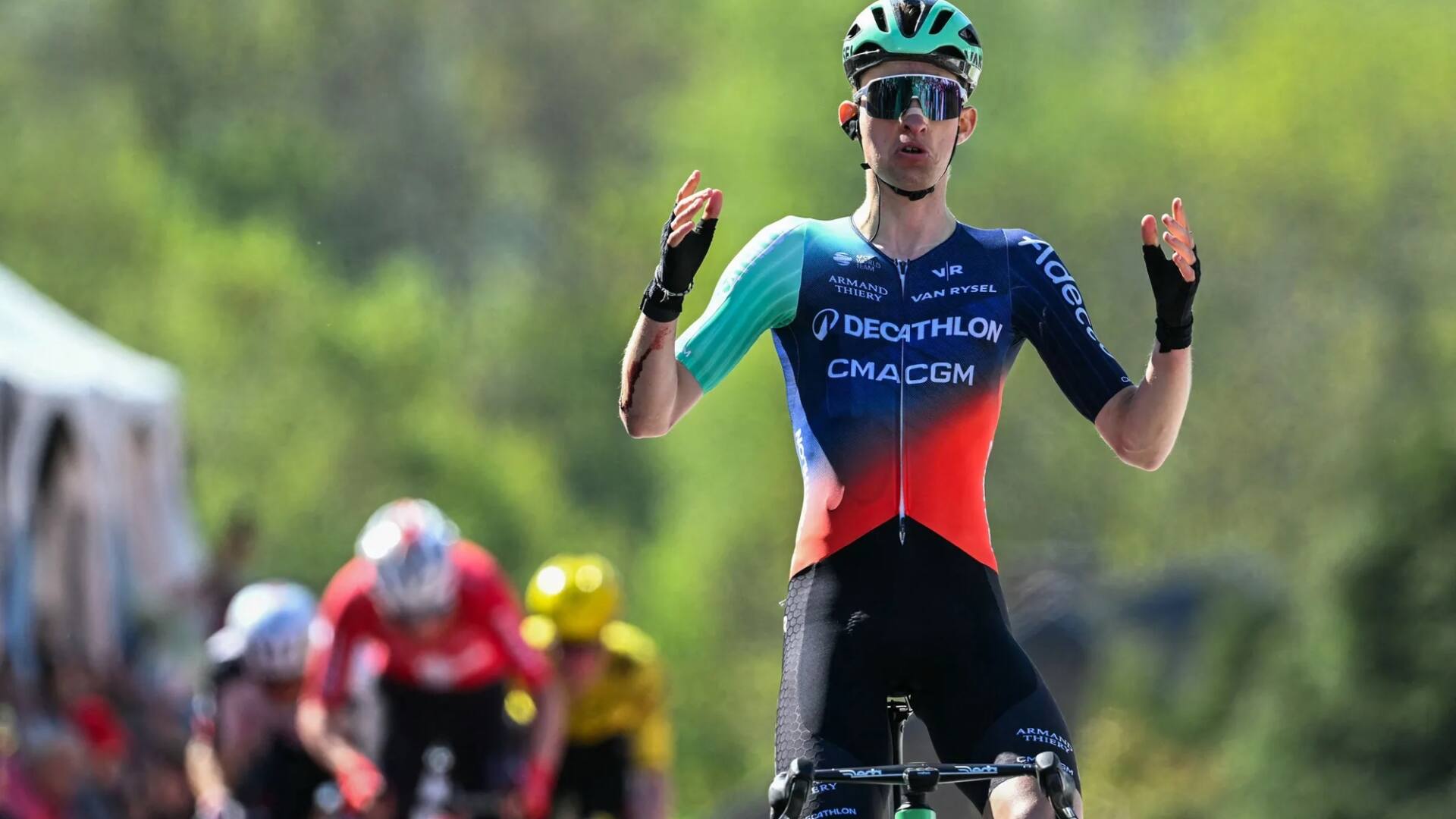
The 2026 Tour de France starts on July 4, 2026 in Barcelona, but another story is already stealing the spotlight: that of Paul Seixas, 19, the youngest starter in the Grande Boucle since 1937. In an edition already promised to a battle between Tadej Pogacar, Jonas Vingegaard and the other general classification favourites, the young Frenchman arrives carrying a weight few debutants ever know: that of a country that has waited decades for a face capable of reviving a genuine yellow-jersey dream. This isn’t just a sports story. It’s a story of global narrative, national pressure and media desire. And for B-EMPIRE Magazine, it’s exactly the kind of story that connects France to a planetary event.
The recent facts are solid. The Guardian explained on July 4, 2026 that Seixas arrives in Barcelona already carrying huge ambition against Pogacar and Vingegaard, with unusual confidence for a rider his age. A few days earlier, Cyclingnews confirmed his place in the Decathlon CMA CGM squad for the Tour, noting he had recovered from a recent crash before resuming an almost normal preparation. Both sources converge on a central point: the hype isn’t an empty media invention. It rests on results, rare maturity, and an already highly visible place in the world cycling conversation.
Why the Paul Seixas story goes far beyond a promising debut
Cycling loves new prodigies, but usually watches them cautiously. In Paul Seixas’s case, something bigger is at play. France isn’t just waiting for a good young rider. It’s waiting for a sign of rupture. Since the great figures of the Hinault era, followed by unfinished or incomplete hopes, the French imagination around the Tour has often swung between nostalgia and frustration. Seixas’s arrival reshapes that feeling. The simple fact that he’s lining up this early at the 2026 Tour is enough to raise the symbolic tension.
That doesn’t mean he has to win in his first participation. That would be too simplistic and not rigorous enough a reading. But the editorial truth lies elsewhere: he enters the race with unusual visibility because he ticks several boxes at once. He’s French. He’s very young. He has already proven he can hold his own against the best on other terrain. And he arrives in a race that remains, by far, the most emotionally charged for the French public.
Openly ambitious against the general classification giants
The most striking passage in The Guardian’s piece may be the simplest: Seixas doesn’t hide behind a mere learning-experience narrative. The paper shows him approaching the Tour aware of the unknown, certainly, but without giving up on the idea of aiming high. This nuance is essential. Many debutants arrive at the Grande Boucle to learn, to show themselves on one stage, or to survive to the finish. He already operates on a different logic, that of a rider thinking about the classification, race reading and the balance of power.
Cyclingnews confirms this tone, noting he was picked by Decathlon CMA CGM with a more central than anecdotal role. The site also highlights his recovery from his crash at the Tour Auvergne-Rhone-Alpes and his team’s displayed confidence in his condition. Editorially, this changes everything. When a debutant isn’t just protected but already entrusted with a real objective, he becomes far more than a French curiosity. He becomes a global character of the Tour.
The France angle is massive, natural and impossible to ignore
For B-EMPIRE Magazine, the France angle doesn’t need to be forced. It’s already at the centre of the story. The Tour de France remains one of the world’s great sporting brands most intimately tied to French identity. When a 19-year-old rider is presented as the youngest starter since 1937 and as one of the possible faces of a new era, the French reading becomes immediate. This isn’t just a technical profile or a sports director’s gamble. It’s a collective projection.
That’s also what makes this story powerful beyond pure sport. A young French face rising at the heart of the world’s biggest cycling event activates several audiences at once: Tour enthusiasts, readers drawn to succession stories, the general public sensitive to new stars, and an entire audience looking to sport for national figures capable of holding a global conversation. In short, Paul Seixas isn’t just a promise within the peloton. He becomes a cultural object of the French sporting summer.
Why the story also speaks to the whole world
What makes the story even stronger is that it doesn’t stay locked in the national narrative. The Tour de France is a global product, broadcast, discussed and consumed well beyond Europe. And in a landscape where Pogacar is already a media superstructure and Vingegaard remains a benchmark of cold power, the arrival of an ultra-offensive young Frenchman offers a perfect new narrative line for the international stage. The sporting world loves these moments when an established event suddenly seems able to welcome a new hero.
By editorial inference from the sources, Seixas brings something many more established leaders can no longer offer with the same intensity: unpredictability. We already know the ceiling of almost every favourite. We know what their dominance, their method, their tactical caution look like. With Seixas, the unknown becomes an attention driver again. Is he too young? Can he hold up for three weeks? Will he go too fast, too soon? Can he surprise as early as the first week? All these questions feed the character’s media value.
Barcelona as the ideal launchpad
The context of this July 4, 2026 amplifies the story further. The Grande Boucle opens in Barcelona with a closely watched team time trial, in a city capable of producing instant global images. The Guardian notes that this first stage could already reshuffle perceptions around teams and leaders. For Seixas, that means his entrance won’t happen in the shadows. It will happen in a highly visible showcase, perfect for setting up a narrative.
This kind of start matters enormously in the age of social media, highlights and Google Discover. The Tour no longer opens just for enthusiasts watching six hours of racing. It also opens for those who’ll see a clip, an image, a name, a number, a sentence. And the Seixas package is remarkably effective: 19 years old, France, historic debut, huge ambition, potential rivalry with Pogacar. It’s an almost ideal editorial line for turning sports news into mass conversation.
The real risk: turning hope into a burden
Still, it’s worth staying rigorous. The story is powerful because it’s stretched between promise and danger. The Guardian notes Seixas arrives with questions about his long-term recovery over a three-week race. Cyclingnews, for its part, noted his recent crash forced adjustments to his preparation. In other words, the fascination shouldn’t obscure the Tour’s physical reality. It’s a race that grinds down even proven champions. For a 19-year-old rider, the margin between revelation and overload remains very thin.
That’s also what makes the story so compelling. If everything were easy, it would be less interesting. The global public wants to see if he can hold his rank. The French public wants to know whether to already believe strongly or keep a strategic reserve. Rival teams, meanwhile, are watching a rider capable of blowing up a race by instinct. This zone of uncertainty is exactly what turns a simple debut into a genuine ongoing story.
The signal B-EMPIRE should note today
Today’s signal is clear: Paul Seixas enters the 2026 Tour de France as far more than a young talent. He enters as a junction point between France, global sports storytelling, and the constant need for new figures at major events. Recent sources show a rider who owns his ambition, recovered from his crash, chosen for a real role, and already placed in the peloton’s highest-level conversation.
Nobody yet knows how far this bet will go. But that’s exactly why it must be watched now. Because even before the big mountains, before Paris, before the final truths of the general classification, one thing is already clear on this July 4, 2026: the world is watching Paul Seixas, and France may finally be seeing the beginning of a story it has waited for a very long time.