

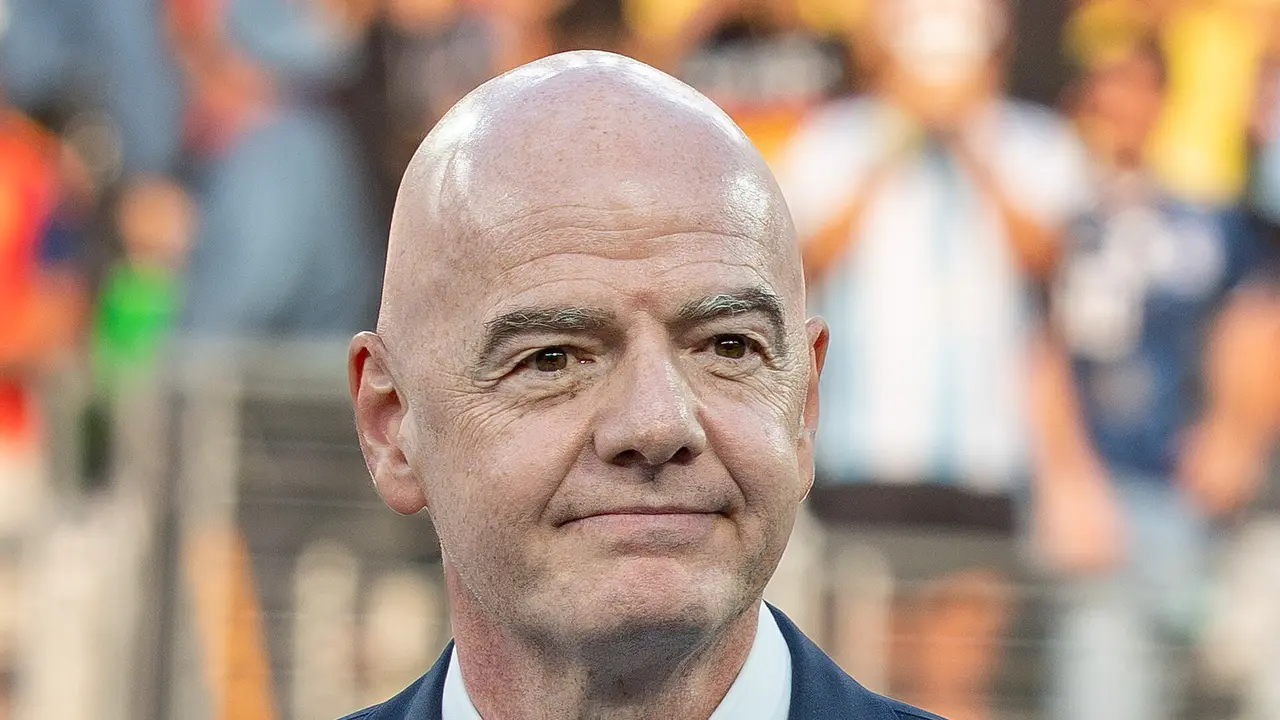
In less than a week, a project valuing FIFA‘s commercial activities at $20 billion triggered a threat of European boycott, an internal revolt, and a spectacular retreat from Gianni Infantino. The president of world football ultimately abandoned the idea of opening the capital of a new company tasked with exploiting major competitions. However, the matter does not end with the withdrawal of the plan. Revelations published on August 4 and 5 show a divided leadership and raise an explosive question: who truly controls the economic future of the World Cup?
The battle extends far beyond leadership squabbles. At the heart of the issue are the revenues from the World Cups, broadcasting rights, partnerships, licenses, and part of the future value of the world’s most popular sport. The project promised immediate resources to federations. Its opponents viewed it as a long-term privatization of a global sports heritage and a disruption of the principle that FIFA belongs to its 211 member associations.
A $20 Billion Company at the Center of the Storm
According to information published by Reuters and detailed by the Associated Press, FIFA was considering the creation of a commercial subsidiary called FIFA Forward Enterprise. This structure would have concentrated the exploitation of its competitions, including the men’s and women’s World Cups, as well as their main sources of revenue. Its proposed valuation reached $20 billion, and about 20% of the capital could have been opened to private investors.
To gain the support of the federations, the plan included significant financial distribution. Each member association could expect an initial payment of $20 million, according to the AP, followed by amounts linked to future commercial performances. On paper, the offer was enticing for smaller federations whose budgets heavily depend on FIFA’s development funds. However, this immediate promise raised a concern: how much power and future revenue would need to be ceded in exchange?
The Boycott Threat That Shifted the Balance of Power
The European opposition was swift and exceptionally harsh. UEFA and its 55 national associations rejected the transfer of interests in FIFA competitions to private capital. The threat was no longer merely legal or symbolic: European teams could refuse to participate in FIFA competitions as long as the proposal remained alive.
Such a boycott would have struck the economic model at its most sensitive point. Without the major European nations, the sporting, television, and commercial value of the tournaments would have been severely diminished. Asia and North America also expressed their opposition, further isolating the project. The standoff demonstrated that FIFA’s power is not absolute: it still depends on teams, confederations, broadcasters, sponsors, and the public.
Gianni Infantino Retreats, but the Crisis Settles In
In a statement released at the end of July 31, Gianni Infantino acknowledged that the project had created divisions incompatible with the stated goal of unity. He thus announced that the proposal would not go any further. This withdrawal avoided an immediate confrontation with UEFA, but it did not close the political file.
On August 4, Le Monde revealed that FIFA Secretary General Mattias Grafström had distanced himself in a message to staff. The operations director, Frenchman Kevin Lamour, had already denounced a project driven by a single person. Carlos Cordeiro, Infantino’s American advisor and former president of the U.S. federation, had resigned. For a leader accustomed to tightly controlling the institution’s communication, this succession of breakages constitutes a major warning.
Ceferin Wins a Decisive Battle for European Football
Aleksander Ceferin emerges strengthened from this sequence. The UEFA president managed to unite often-divided European federations and transform their sporting weight into political leverage. According to the portrait published by Le Monde on August 5, his counter-offensive trapped Infantino in an impossible alternative: maintain the project and risk a historic fracture, or retreat and appear weakened.
This victory recalls the mobilization that thwarted the closed Super League in 2021. In both cases, the central argument concerns ownership and control of football. Proponents of the European model argue that competitions cannot be treated as mere financial assets, as their value also comes from the participation of clubs, players, teams, and supporters.
Why Private Investors Are Interested in Global Football
The interest of funds is not mysterious. Football offers global audiences, recurring broadcasting rights, ticketing revenues, licenses, data, and opportunities for digital development. The 2026 World Cup, hosted in the United States, Canada, and Mexico, has further expanded the tournament to 48 teams and 104 matches. This growth makes the ecosystem more attractive to capital seeking rare and internationally identifiable assets.
However, private capital generally expects a return, influence on strategy, and long-term visibility. A minority stake can thus impact scheduling, formats, ticket prices, broadcasting times, or the creation of new competitions. The debate does not simply oppose modernity and tradition. It concerns the distribution of risk, profits, and decision-making power.
The France Point: A French Executive at the Center of the Revolt
France is directly involved in this crisis. Kevin Lamour, FIFA’s operations director and former executive of the French Football Federation, has publicly distanced himself from the project. His intervention gives a French dimension to a global affair and shows that dissent does not come solely from outside the institution.
For the FFF and other European federations, the withdrawal of the plan temporarily protects their collective influence. However, it does not resolve tensions surrounding scheduling, the proliferation of matches, and revenue sharing. Players in French clubs are already exposed to an increasing density of competitions. Any new financial logic that could add matches or increase commercial pressure will thus have concrete consequences in Ligue 1 and the French national team.
A Victory for Opponents, Not Yet a FIFA Reform
The withdrawal of FIFA Forward Enterprise is a clear victory for its opponents. It proves that a coalition of confederations can halt a project supported at the top. However, no structural reform has yet been announced to ensure greater transparency, consultation, or oversight. The same debate could return in another form, with a reduced scope or a different financial proposal.
The real consequence of this week is thus political. Gianni Infantino retains his position, but his authority has been publicly challenged by essential partners and officials from his own administration. After a gigantic 2026 World Cup, global football discovers that its record commercial value can also become its main fault line. The $20 billion project is abandoned; the battle over who owns the game has only just begun.
Sources
- Associated Press, “Infantino abandons plans to sell World Cup profits to private equity”, July 31, 2026.
- Associated Press, European opposition and boycott threat, July 30, 2026.
- Le Monde, revelations about internal dissent at FIFA, August 4, 2026.
- Le Monde, portrait of Aleksander Ceferin and account of Infantino’s retreat, August 5, 2026.
- Reuters via Boursorama, initial presentation of the commercial project, July 28, 2026.


